This is one of several portraits Picasso painted of Fernande Olivier, during the summer of 1909, a period that the couple spent in Picasso's native Spain. While the pears in the background are modeled in the round, Picasso radically reconfigured Oliviers head and bust, fragmenting them into geometrical segments. This fracturing of solid volumes offered an alternative to the traditional illusionistic and perspectival approach to depicting three–dimensional space on a two–dimensional surface and suggests the direction Picasso's process would take in the development of Cubism.
2009.
Explore more
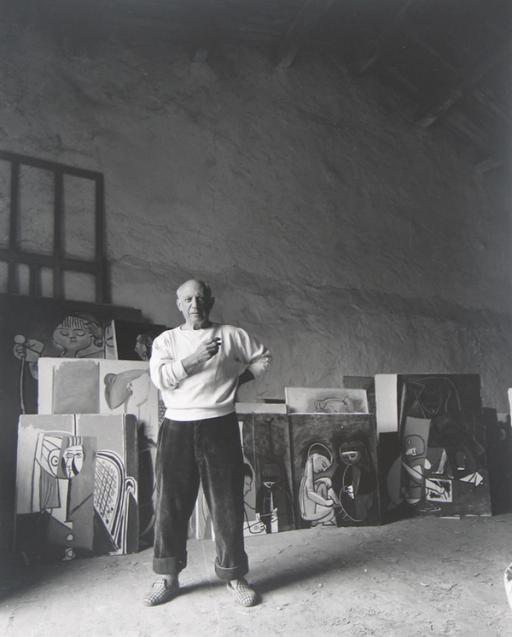
Pablo Picasso
Spanish, 1881–1973 1251 works onlineWith these words, Picasso shed light on two central principles of his artistic production over nearly 80 years: his openness to a diverse range of styles, subject matters, and mediums, and his resistance to the notion that change in art necessarily corresponds to improvement or progress.
Learn more →
From MoMA Design Store


Installation views
We have identified this work in the following photos from our exhibition history.
Provenance Research Project
This work is included in the Provenance Research Project, which investigates the ownership history of works in MoMA's collection.
[Galerie Kahnweiler, Paris and/or Ambroise Vollard, Paris and/or Galerie Thannhauser, Munich]
By September 7, 1919 (1912 or 1913?) - at least October 1932, Alfred Flechtheim and/or Galerie Flechtheim, Düsseldorf, Berlin and London.
By February 1934(?) - March 1937, The Mayor Gallery and/or Douglas Cooper, London.
March 1937, Pierre Matisse Gallery (consignment no. 882, stock no. 594), New York, purchased from “Cooper”.
March 31, 1937 - June 2, 1955, Walter P. Chrysler, Jr., New York, purchased from Pierre Matisse Gallery.
June 2, 1955 - 1996, Florene May Marx (1903-1995, later Schoenborn) and Samuel A. Marx (1948–1964), Chicago, purchased from Walter P. Chrysler, Jr. through M. Knoedler & Co. (consignment no. 4786), New York.
1996, The Museum of Modern Art, New York, acquired as bequest from Florene May Schoenborn.
Provenance research is a work in progress, and is frequently updated with new information. If you have any questions or information to provide about the listed works, please email [email protected] or write to:
Provenance Research Project
The Museum of Modern Art
11 West 53 Street
New York, NY 10019
Licensing
Artwork or archival images
If you would like to reproduce an image of a work of art in MoMA's collection, or an image of a MoMA publication or archival material (including installation views, checklists, and press releases), please contact Art Resource (publication in North America) or Scala Archives (publication in all other geographic locations).
Audio and film clips
MoMA licenses archival audio and select out of copyright film clips from our film collection. At this time, MoMA produced video cannot be licensed by MoMA/Scala. All requests to license archival audio or out of copyright film clips should be addressed to Scala Archives at [email protected]. Motion picture film stills cannot be licensed by MoMA/Scala. For access to motion picture film stills for research purposes, please contact the Film Study Center at [email protected]. For more information about film loans and our Circulating Film and Video Library, please visit Circulating Film and Video Library.
Text from a publication or the archives
If you would like to reproduce text from a MoMA publication, please email [email protected]. If you would like to publish text from MoMA's archival materials, please fill out this permission form and send to [email protected].
Feedback
This record is a work in progress. If you have additional information or spotted an error, please fill out this feedback form.