Canadian-born Agnes Martin made this work soon after moving to New York, where she kept a studio on Coenties Slip, a street in Lower Manhattan where other artists, including Ellsworth Kelly, Jack Youngerman, and Robert Indiana, also lived and worked. This setting, so close to the East River that she “could see the expressions on the faces of the sailors,” is invoked in the pale blue-gray palette and the chalky, almost watery paint of the abstract geometric composition of Harbor Number 1. Soon after this work was made, Martin would develop her signature style—grids hand-drawn in pencil on large square canvases—which would remain her primary compositional approach for the rest of her career.
Studio Visit: Selected Gifts from Agnes Gund, 2018
Explore more
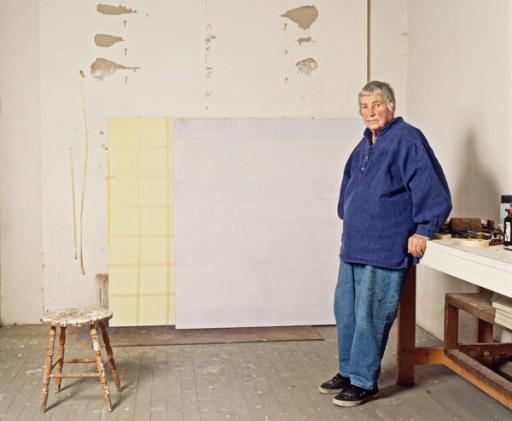
Agnes Martin
American, born Canada. 1912–2004 55 works onlineBorn on a farm in rural Saskatchewan, Canada, Agnes Martin immigrated to the United States in 1932 in the hopes of becoming a teacher.
Learn more →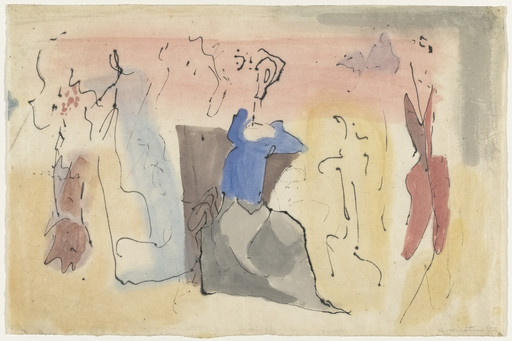

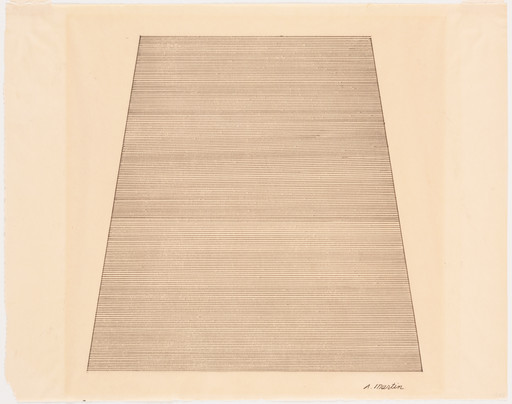

Coenties Slip
For a brief period in the 1950s and ’60s, an out-of-the-way street at the southeastern edge of Manhattan hosted a community of artists whose work there would change art history.
Learn more →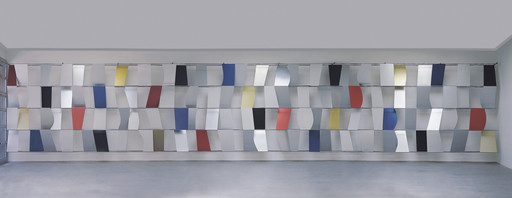

From MoMA Design Store


Installation views
We have identified this work in the following photos from our exhibition history.
Licensing
Artwork or archival images
If you would like to reproduce an image of a work of art in MoMA's collection, or an image of a MoMA publication or archival material (including installation views, checklists, and press releases), please contact Art Resource (publication in North America) or Scala Archives (publication in all other geographic locations).
Audio and film clips
MoMA licenses archival audio and select out of copyright film clips from our film collection. At this time, MoMA produced video cannot be licensed by MoMA/Scala. All requests to license archival audio or out of copyright film clips should be addressed to Scala Archives at [email protected]. Motion picture film stills cannot be licensed by MoMA/Scala. For access to motion picture film stills for research purposes, please contact the Film Study Center at [email protected]. For more information about film loans and our Circulating Film and Video Library, please visit Circulating Film and Video Library.
Text from a publication or the archives
If you would like to reproduce text from a MoMA publication, please email [email protected]. If you would like to publish text from MoMA's archival materials, please fill out this permission form and send to [email protected].
Feedback
This record is a work in progress. If you have additional information or spotted an error, please fill out this feedback form.