Oil on canvas
Picasso painted The Kitchen in November 1948, on the thirty-year anniversary of the death of the poet Guillaume Apollinaire, his dear friend. Picasso used his kitchen, a large, white, empty room, as a subject in order to make a painting, he reported, "out of nothing." He created the somber, existential work at the end of a series of large-scale monochromatic paintings, including the monumental Guernica (1937), all of which depict scenes of violent turmoil. He had also recently returned from his first visit to the Nazi concentration camp in Auschwitz, Poland, and the work's restricted, mute abstraction may be a response to Europe's recent atrocities as well as the loss of a great friend.
2015.
Gallery label from 2010.
Picasso painted The Kitchen in November 1948, on the thirty-year anniversary of the death of the poet Guillaume Apollinaire, his dear friend, and just seven days after Apollinaire's widow asked Picasso to revisit an earlier memorial project. Twenty years before, Picasso had designed the commemorative sculpture Monument to Apollinaire, but the Apollinaire Committee had deemed it too abstract to suit its purpose (a later version is on display in the Museums Sculpture Garden).
The Kitchen's wiry linearity evokes Monument to Apollinaire. Picasso used his kitchen, a large, white, empty room, as a subject in order to make a painting, he reported, "out of nothing." He created the somber, existential work at the end of a series of large-scale monochromatic paintings, including the monumental Guernica (1937), all of which depict scenes of violent turmoil. He had also recently returned from his first visit to the Nazi concentration camp in Auschwitz, Poland, and the works restricted, mute abstraction may be a response to Europe's recent atrocities as well as the loss of a great friend.
2010.
Explore more
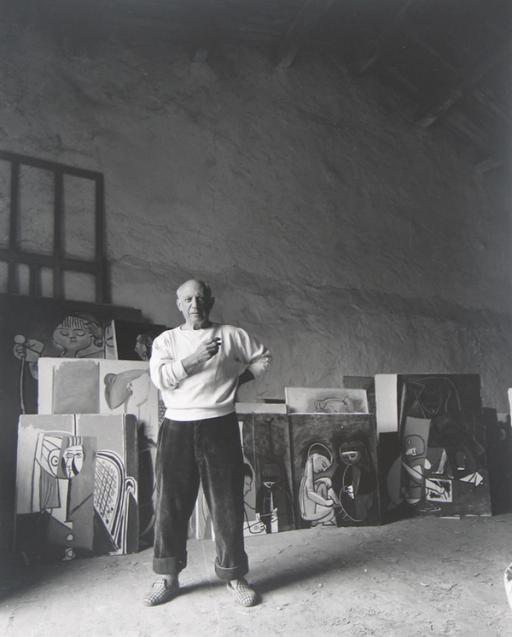
Pablo Picasso
Spanish, 1881–1973 1257 works onlineWith these words, Picasso shed light on two central principles of his artistic production over nearly 80 years: his openness to a diverse range of styles, subject matters, and mediums, and his resistance to the notion that change in art necessarily corresponds to improvement or progress.
Learn more →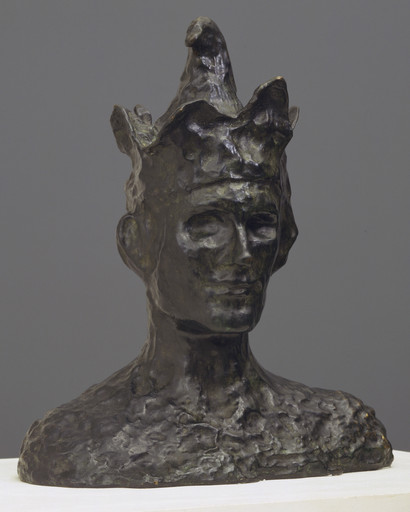

Présence Africaine
Gallery 520In the 1930s and 1940s, Paris was a mecca for Black artists, writers, musicians, and intellectuals from around the world.
Learn more →
From MoMA Design Store


Installation views
We have identified this work in the following photos from our exhibition history.
Licensing
Artwork or archival images
If you would like to reproduce an image of a work of art in MoMA's collection, or an image of a MoMA publication or archival material (including installation views, checklists, and press releases), please contact Art Resource (publication in North America) or Scala Archives (publication in all other geographic locations).
Audio and film clips
MoMA licenses archival audio and select out of copyright film clips from our film collection. At this time, MoMA produced video cannot be licensed by MoMA/Scala. All requests to license archival audio or out of copyright film clips should be addressed to Scala Archives at [email protected]. Motion picture film stills cannot be licensed by MoMA/Scala. For access to motion picture film stills for research purposes, please contact the Film Study Center at [email protected]. For more information about film loans and our Circulating Film and Video Library, please visit Circulating Film and Video Library.
Text from a publication or the archives
If you would like to reproduce text from a MoMA publication, please email [email protected]. If you would like to publish text from MoMA's archival materials, please fill out this permission form and send to [email protected].
Feedback
This record is a work in progress. If you have additional information or spotted an error, please fill out this feedback form.