Discussing this painting, Frankenthaler described its intended meaning, its protracted making, and its innovative materiality. It is part of a series “involved in inner amorphous worlds or depths exploding on the surface and in perspective.” To achieve that, she “used tube paint, turpentine, enamel. Started the picture, worked on it for weeks on and off, wasn’t pleased, put it aside. Picked it up again months later, ‘saved’ portions of it. Black was the final gesture.”
2025
Gallery label from Making Space: Women Artists and Postwar Abstraction, April 19 - August 13, 2017
Frankenthaler described this painting as part of a series "involved in inner amorphous worlds or depths exploding on the surface and in perspective, and held at points by local blocks of paint." To create this illusion of depth, Frankenthaler thinned her pigments with turpentine so that they would soak directly into the canvas and stain it. She rarely used the color black, but here her technique of stain-painting enables it, in the artist's words, to "act as a color shape, not as black line or 'stable binder.'"
Making Space: Women Artists and Postwar Abstraction, April 19 - August 13, 2017
Explore more
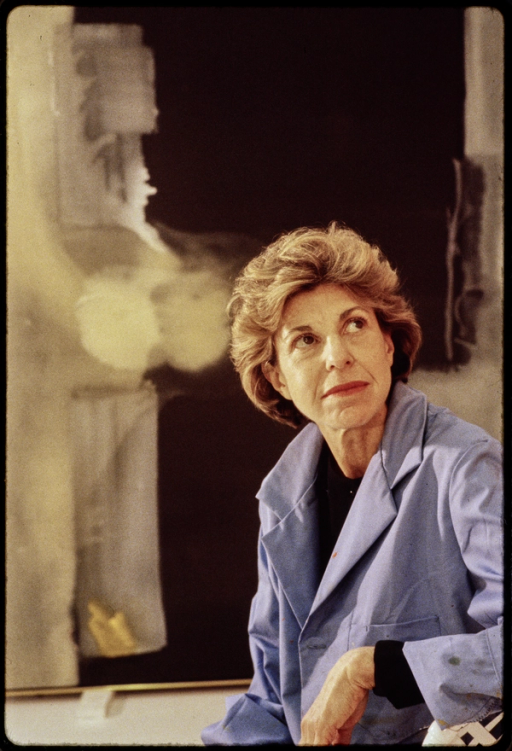
Helen Frankenthaler
American, 1928–2011 77 works onlineThe artist Helen Frankenthaler has offered two childhood scenes as foundational stories for the path her innovative practice would take.
Learn more →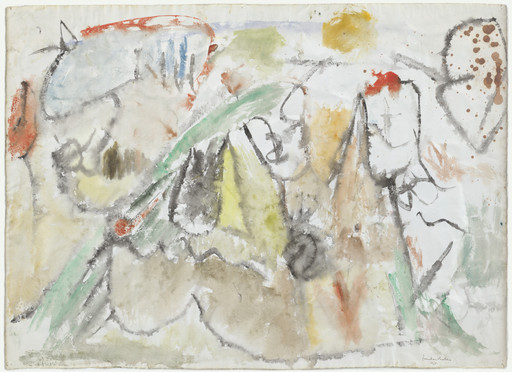
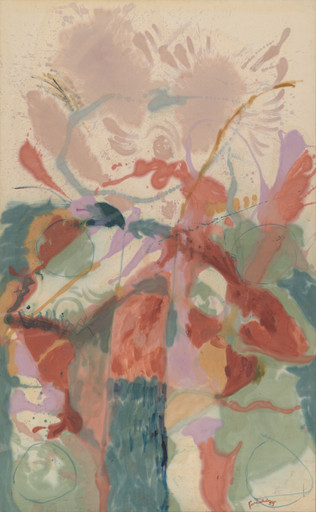
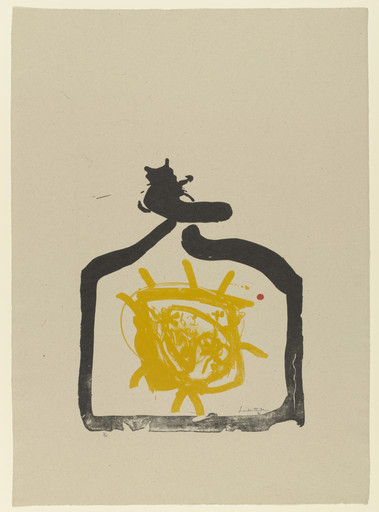

Audio
Audio from the playlist Helen Frankenthaler: A Grand Sweep
Articles and videos
From MoMA Design Store


Installation views
We have identified this work in the following photos from our exhibition history.
Licensing
Artwork or archival images
If you would like to reproduce an image of a work of art in MoMA's collection, or an image of a MoMA publication or archival material (including installation views, checklists, and press releases), please contact Art Resource (publication in North America) or Scala Archives (publication in all other geographic locations).
Audio and film clips
MoMA licenses archival audio and select out of copyright film clips from our film collection. At this time, MoMA produced video cannot be licensed by MoMA/Scala. All requests to license archival audio or out of copyright film clips should be addressed to Scala Archives at [email protected]. Motion picture film stills cannot be licensed by MoMA/Scala. For access to motion picture film stills for research purposes, please contact the Film Study Center at [email protected]. For more information about film loans and our Circulating Film and Video Library, please visit Circulating Film and Video Library.
Text from a publication or the archives
If you would like to reproduce text from a MoMA publication, please email [email protected]. If you would like to publish text from MoMA's archival materials, please fill out this permission form and send to [email protected].
Feedback
This record is a work in progress. If you have additional information or spotted an error, please fill out this feedback form.