With its areas of thinned oil paint soaked into raw canvas, this work demonstrates the staining technique that would become Frankenthaler’s signature contribution to abstract painting. While this process was experimental within the context of New York’s midcentury art world, the painting’s title and composition have a more traditional reference: Spanish painter José de Ribera’s biblically themed Jacob’s Dream (1639), which Frankenthaler had admired several years earlier at Madrid’s El Museo Nacional del Prado. “The picture developed (bit by bit while I was working on it) into shapes symbolic of an exuberant figure and ladder,” she explained, “therefore Jacob’s Ladder.”
Helen Frankenthaler: A Grand Sweep, November 18, 2025–February 8, 2026
Publication excerpt from MoMA Highlights: 375 Works from The Museum of Modern Art, New York (New York: The Museum of Modern Art, 2019)
As Frankenthaler worked on this painting, its forms came to suggest a ladderlike structure topped by what she called an “exuberant figure,” reminding her of the biblical narrative referred to in the work’s title. In the Old Testament Book of Genesis, the patriarch Jacob, while fleeing his murderous brother Esau, has a dream in which he envisions a ladder connecting the earth to heaven; God appears and issues a blessing and a pledge of devotion to Jacob and his descendants.
Frankenthaler evoked the symbolic features of the story through a combination of techniques that she had begun to employ in the 1950s. The image of a ladder emerged from a rectangular segment that Frankenthaler reinforced with relatively controlled, parallel brushstrokes, much the same way that the rungs of a ladder are constructed in real life. The “exuberant” aspects of the painting were applied more loosely, unbounded by contours. Frankenthaler used an unmediated process in these areas, allowing thinned oil paint to seep directly into unprimed canvas and yield chance effects produced by the pigment itself. Over the course of the next decade, Frankenthaler’s works would come to be marked by these sublime expanses of stained color, her signature contribution to the history of abstract painting.
MoMA Highlights: 375 Works from The Museum of Modern Art, New York (New York: The Museum of Modern Art, 2019)
Explore more
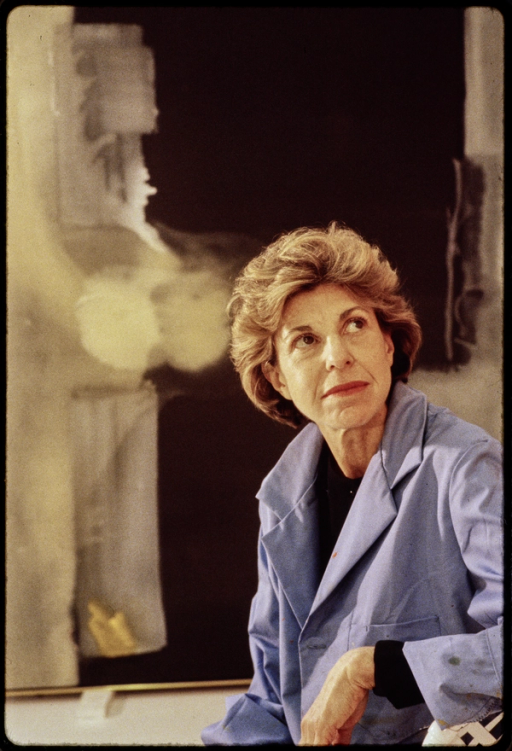
Helen Frankenthaler
American, 1928–2011 77 works onlineThe artist Helen Frankenthaler has offered two childhood scenes as foundational stories for the path her innovative practice would take.
Learn more →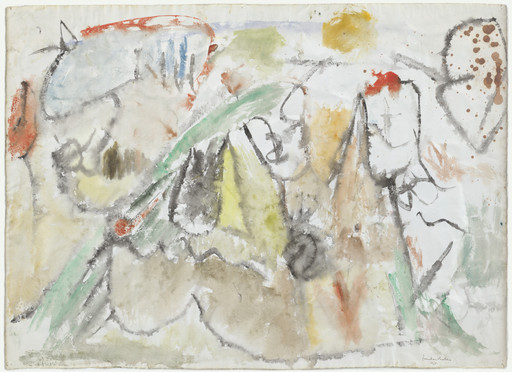

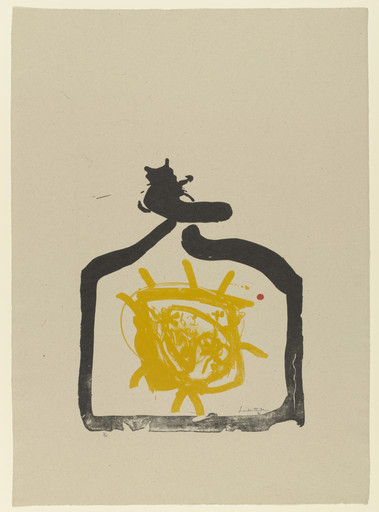
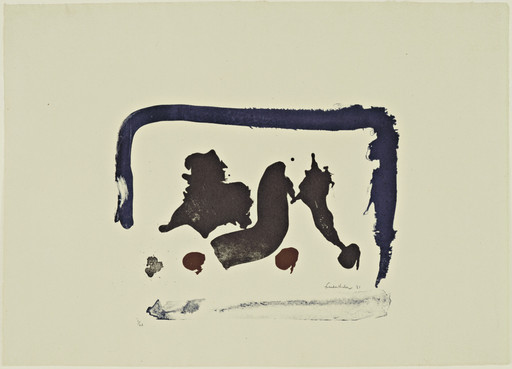
Abstract Expressionism
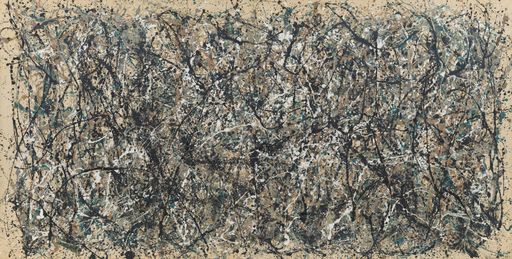
The dominant artistic movement in the 1940s and 1950s, Abstract Expressionism was the first to place New York City at the forefront of international modern art.
Learn more →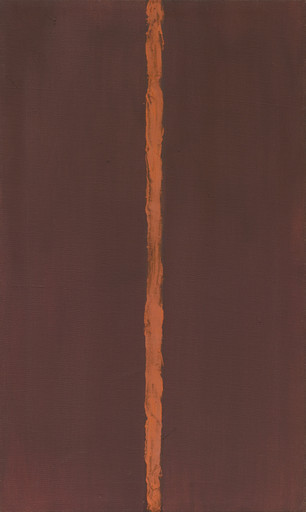
Canvas
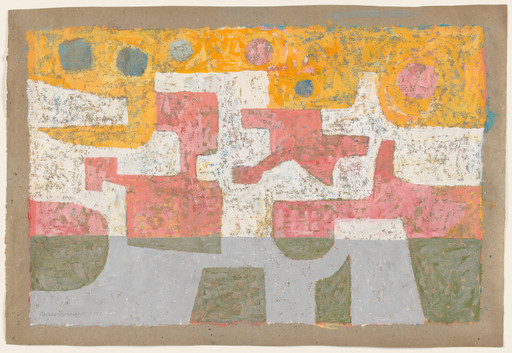
A closely woven, sturdy cloth of hemp, cotton, linen, or a similar fiber, frequently stretched over a frame and used as a surface for painting.
Learn more →

Stain
Paint thinned with solvent and applied to the canvas like a wash. Rather than remaining on the surface, a stain is absorbed into the canvas.
Learn more →


Audio
Audio from the playlist Helen Frankenthaler: A Grand Sweep
Articles and videos
From MoMA Design Store


Installation views
We have identified this work in the following photos from our exhibition history.
Licensing
Artwork or archival images
If you would like to reproduce an image of a work of art in MoMA's collection, or an image of a MoMA publication or archival material (including installation views, checklists, and press releases), please contact Art Resource (publication in North America) or Scala Archives (publication in all other geographic locations).
Audio and film clips
MoMA licenses archival audio and select out of copyright film clips from our film collection. At this time, MoMA produced video cannot be licensed by MoMA/Scala. All requests to license archival audio or out of copyright film clips should be addressed to Scala Archives at [email protected]. Motion picture film stills cannot be licensed by MoMA/Scala. For access to motion picture film stills for research purposes, please contact the Film Study Center at [email protected]. For more information about film loans and our Circulating Film and Video Library, please visit Circulating Film and Video Library.
Text from a publication or the archives
If you would like to reproduce text from a MoMA publication, please email [email protected]. If you would like to publish text from MoMA's archival materials, please fill out this permission form and send to [email protected].
Feedback
This record is a work in progress. If you have additional information or spotted an error, please fill out this feedback form.