Oil, gouache, and plaster on canvas
The figure in this painting may allude to the myth of the city of Rome’s birth, in which twin founders Romulus and Remus were nursed in infancy by a wolf. Although Pollock refused to specifically identify the subject, this work is nevertheless a powerful example of the archetypal symbolism that he explored during his early years. His interest in symbolism may be linked to his encounters with Surrealist artists displaced by the war, especially those in the orbit of Peggy Guggenheim’s Art of This Century gallery in New York. The She-Wolf featured in Pollock’s first solo exhibition at that gallery in 1943.
522: Art of This Century, 2025
Publication excerpt from The Museum of Modern Art, MoMA Highlights , New York: The Museum of Modern Art, revised 2004, originally published 1999.
When Pollock painted The She-Wolf he had not yet arrived at his so-called "drip" style, one of the great inventions of Abstract Expressionism. The canvas's traces of multicolored washes and spatters show that a free-form abstraction and an unfettered play of materials were already parts of his process; but in this work and others his focus is a compound of mythology and an iconography of the unconscious. (He was influenced here both by Surrealism and his own Jungian analysis.) Perhaps Pollock's she-wolf is the legendary foster-mother to Romulus and Remus, the founders of ancient Rome. But he himself refused to identify her, saying, "She-Wolf came into existence because I had to paint it. Any attempt on my part to say something about it, to attempt explanation of the inexplicable, could only destroy it."
Drawn in heavy black and white lines, the wolf advances leftward. Her body is overlaid with abstract lines and patches, a thick, unreadable calligraphy that spreads throughout the canvas. These hieroglyphic intimations, along with the somber palette and the conjuring of myth, reflect the climate of a period shadowed by war. Intended to approach ultimate human mysteries, they were to be simultaneously meaningful and unknowable.
The Museum of Modern Art, MoMA Highlights, New York: The Museum of Modern Art, revised 2004, originally published 1999.
Explore more
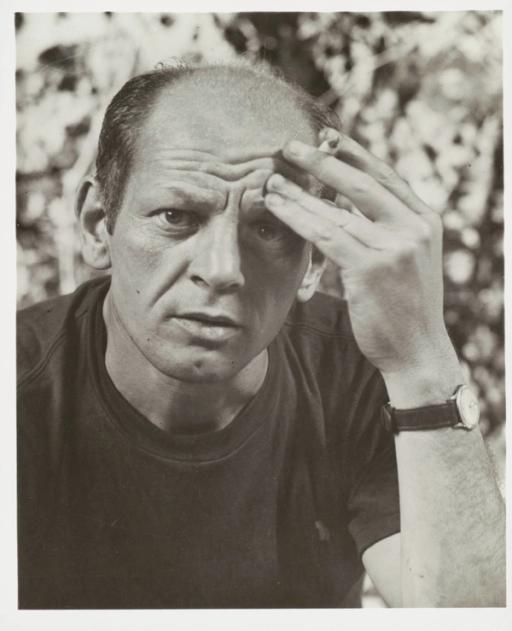
Jackson Pollock
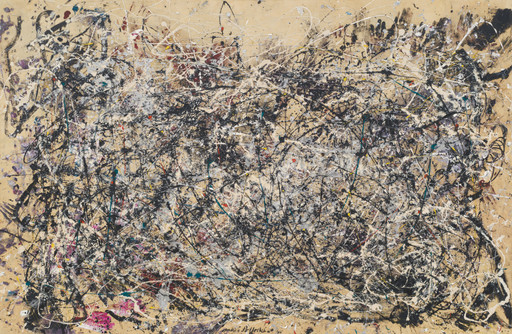
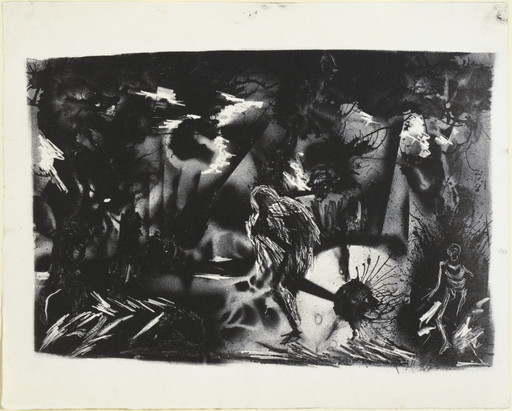
American, 1912–1956 86 works onlineIn 1947 Jackson Pollock arrived at a new mode of working that brought him international fame. His method consisted of flinging and dripping thinned enamel paint onto an unstretched canvas laid on the floor of his studio.
Learn more →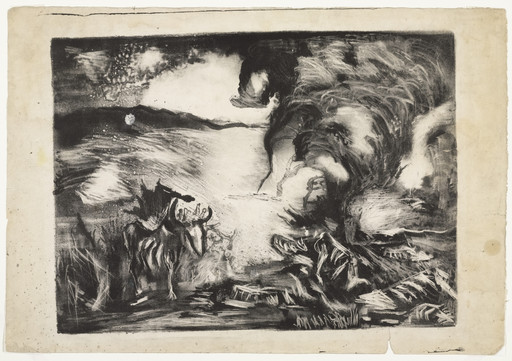

Art of This Century
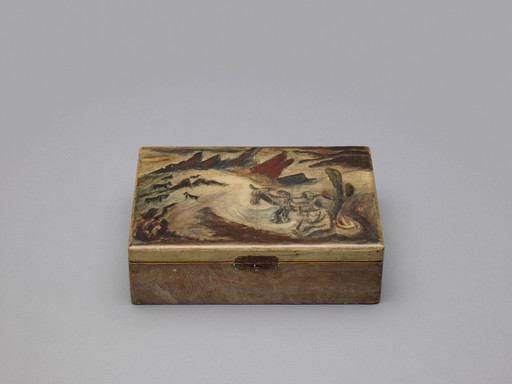
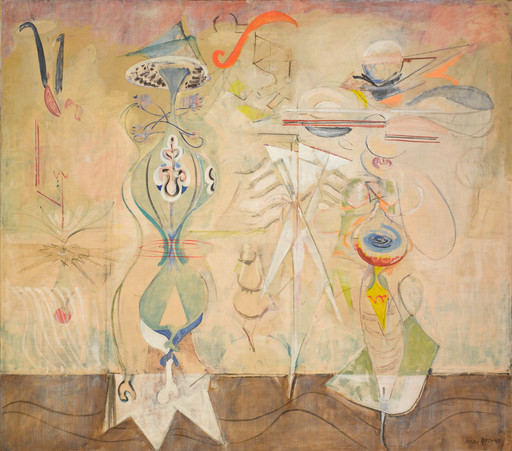
Gallery 522In the 1940s the New York City art world expanded with the arrival of European émigrés escaping World War II.
Learn more →
Audio
Audio from the playlist 1880–1950: Works from the Collection
From MoMA Design Store


Installation views
We have identified this work in the following photos from our exhibition history.
Licensing
Artwork or archival images
If you would like to reproduce an image of a work of art in MoMA's collection, or an image of a MoMA publication or archival material (including installation views, checklists, and press releases), please contact Art Resource (publication in North America) or Scala Archives (publication in all other geographic locations).
Audio and film clips
MoMA licenses archival audio and select out of copyright film clips from our film collection. At this time, MoMA produced video cannot be licensed by MoMA/Scala. All requests to license archival audio or out of copyright film clips should be addressed to Scala Archives at [email protected]. Motion picture film stills cannot be licensed by MoMA/Scala. For access to motion picture film stills for research purposes, please contact the Film Study Center at [email protected]. For more information about film loans and our Circulating Film and Video Library, please visit Circulating Film and Video Library.
Text from a publication or the archives
If you would like to reproduce text from a MoMA publication, please email [email protected]. If you would like to publish text from MoMA's archival materials, please fill out this permission form and send to [email protected].
Feedback
This record is a work in progress. If you have additional information or spotted an error, please fill out this feedback form.