Oil on canvas
Edward Hopper produced closely observed urban views, landscapes (largely of New England), and interior scenes—all either devoid of or sparsely populated by people. Though he insisted that his paintings were straightforward representations of the real world, their overall sparseness imbues them with a sense of loneliness, estrangement, and stillness. Light, whether from electric bulbs or the sun, defines the places he depicts and shapes the mood of his works. A late afternoon glow pervades House by the Railroad, which features a grand Victorian home fronted by the tracks of a railroad. The tracks create a visual barrier that seems to block access to house, which appears moored and isolated in the surrounding empty landscape. Its old-fashioned architecture and lack of any sense of occupancy imply that the house may be a relic of tradition, lonely and forgotten in the push towards urbanization and progress, as suggested by the railroad tracks.
2016.
Publication excerpt from MoMA Highlights: 375 Works from The Museum of Modern Art, New York (New York: The Museum of Modern Art, 2019)
A late-afternoon glow pervades Hopper’s House by the Railroad, which features a grand Victorian home, its base and grounds obscured by the tracks of a railroad. The tracks create a visual barrier that seems to block access to the house, which is isolated in an empty landscape. The juxtaposition of the house and the railroad tracks may be read as a confrontation between the fixity of tradition and the possibility of mobility in early-twentieth-century America. At the same time, these effects evoke the quiet yet charged atmosphere that would become a hallmark of this artist’s work.
Hopper produced closely observed urban views, landscapes (largely of New England), and interior scenes—all sparsely populated with figures or devoid of them entirely. Although he insisted that his paintings were straightforward representations of the real world, they are often filled with an unmistakable sense of loneliness, estrangement, stillness, and mystery. Light, whether natural or artificial, plays a central role in conjuring mood.
In 1929–30 House by the Railroad was featured in Paintings by 19 Living Americans, The Museum of Modern Art’s first exhibition devoted exclusively to American art. It was acquired by MoMA in 1930, one of the first works to enter the Museum’s collection.
MoMA Highlights: 375 Works from The Museum of Modern Art, New York (New York: The Museum of Modern Art, 2019)
Explore more

American Idioms
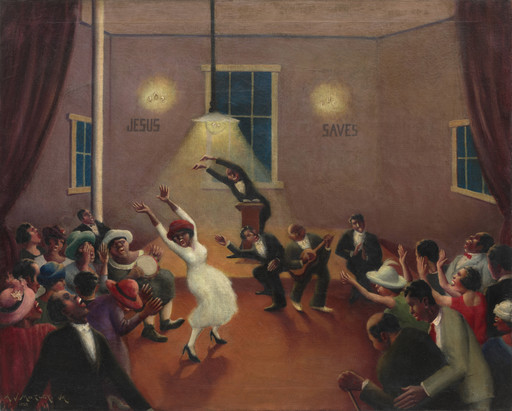
Gallery 521From the Great Depression through World War II, the United States experienced a period of turbulence and transformation. Informed by shifting social and economic dynamics at home and abroad, artists developed unique approaches to narrative art in diverse styles and mediums.
Learn more →

Audio
Audio from the playlist Kids
Audio from the playlist 1880–1950: Works from the Collection
From MoMA Design Store


Installation views
We have identified this work in the following photos from our exhibition history.
Licensing
Artwork or archival images
If you would like to reproduce an image of a work of art in MoMA's collection, or an image of a MoMA publication or archival material (including installation views, checklists, and press releases), please contact Art Resource (publication in North America) or Scala Archives (publication in all other geographic locations).
Audio and film clips
MoMA licenses archival audio and select out of copyright film clips from our film collection. At this time, MoMA produced video cannot be licensed by MoMA/Scala. All requests to license archival audio or out of copyright film clips should be addressed to Scala Archives at [email protected]. Motion picture film stills cannot be licensed by MoMA/Scala. For access to motion picture film stills for research purposes, please contact the Film Study Center at [email protected]. For more information about film loans and our Circulating Film and Video Library, please visit Circulating Film and Video Library.
Text from a publication or the archives
If you would like to reproduce text from a MoMA publication, please email [email protected]. If you would like to publish text from MoMA's archival materials, please fill out this permission form and send to [email protected].
Feedback
This record is a work in progress. If you have additional information or spotted an error, please fill out this feedback form.