Lies Ros and Rob Schroder, former classmates at the Gerrit Rietveld Academy in Amsterdam, founded the Wild Plakken graphic design collective in 1977. Its Dutch name translates as "wild pasting" and refers to the group's early practice of pasting posters illegally around the Amsterdam city center. Since these revolutionary beginnings, Wild Plakken has continued to use design as a tool for political activism, preferring to work with socially and politically engaged clients. The group designed this poster for the Anti-Apartheid Movement of the Netherlands. It depicts two female heads, each composed of dark- and light-skinned halves. The oppositional nature of the apartheid conflict is evident in the binary composition of the poster. The seam between the red and blue top and bottom halves of the poster is overlaid with the slogan "Women Against Apartheid," illustrating its mission of unification.
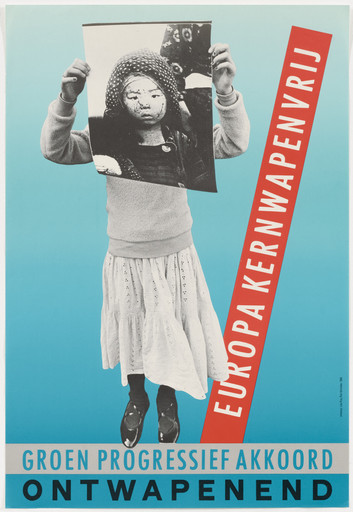
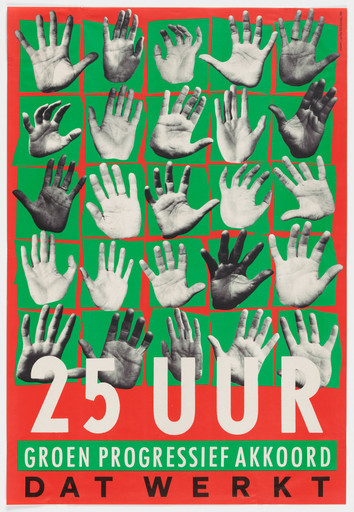
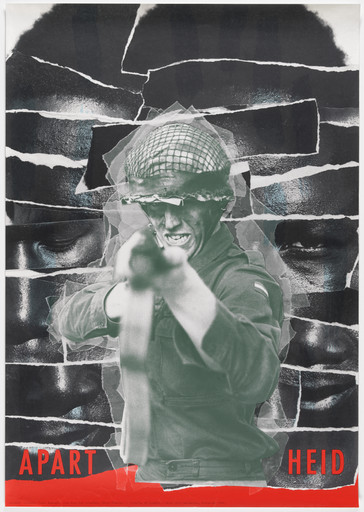
Influenced by early-twentieth-century avant-garde experimentation with collage, Wild Plakken creates compositions of fragmented images juxtaposed with vibrantly colored shapes that have a spontaneous handmade quality. Its members believe that conceptual content, drawn from the client's perspective and objectives, should determine a design’s appearance; their central aim is to incite a reaction in the viewer and raise social awareness. By combining disparate elements into collaged compositions, they obscure their own authorship, letting image and text speak directly for a political cause.
The Museum of Modern Art, MoMA Highlights since 1980, New York: The Museum of Modern Art, 2007, p. 55.
Explore more

From MoMA Design Store


Installation views
We have identified this work in the following photos from our exhibition history.
Licensing
Artwork or archival images
If you would like to reproduce an image of a work of art in MoMA's collection, or an image of a MoMA publication or archival material (including installation views, checklists, and press releases), please contact Art Resource (publication in North America) or Scala Archives (publication in all other geographic locations).
Audio and film clips
MoMA licenses archival audio and select out of copyright film clips from our film collection. At this time, MoMA produced video cannot be licensed by MoMA/Scala. All requests to license archival audio or out of copyright film clips should be addressed to Scala Archives at [email protected]. Motion picture film stills cannot be licensed by MoMA/Scala. For access to motion picture film stills for research purposes, please contact the Film Study Center at [email protected]. For more information about film loans and our Circulating Film and Video Library, please visit Circulating Film and Video Library.
Text from a publication or the archives
If you would like to reproduce text from a MoMA publication, please email [email protected]. If you would like to publish text from MoMA's archival materials, please fill out this permission form and send to [email protected].
Feedback
This record is a work in progress. If you have additional information or spotted an error, please fill out this feedback form.