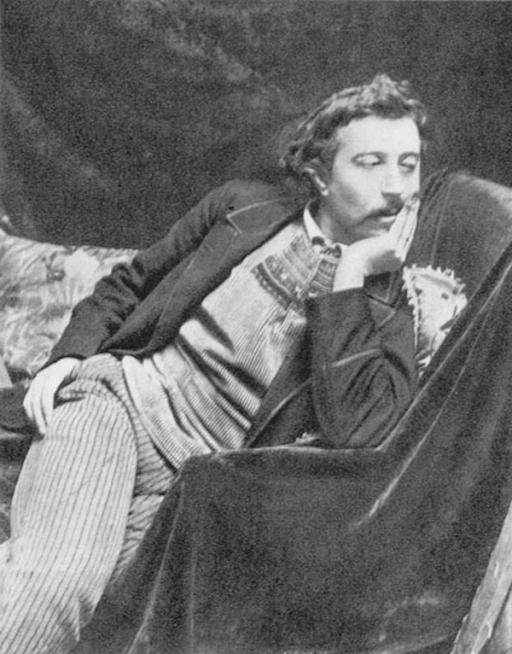
Paul Gauguin

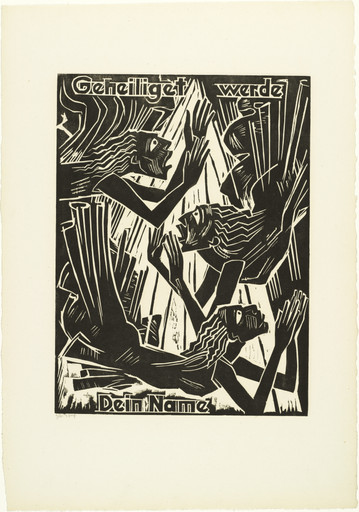
Noa Noa (Fragrant Scent), state III/III, from the suite Noa Noa (Fragrant Scent)

1893–94

Woodcut

Not on view

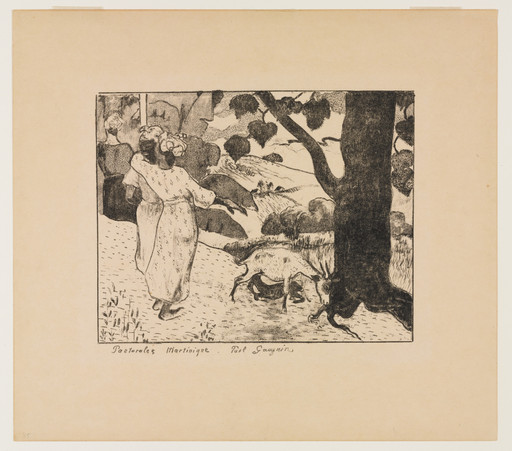
Ever seized by wanderlust, Paul Gauguin sought to abandon the European life he viewed as conventional and artificial in favor of one in tune with nature and free of the constraints of Western social mores. In search of a more vital and authentic way of life, he made his first sojourn to Tahiti in 1891. Although the island was not the untouched Eden he had hoped for, he was still greatly inspired by the people, culture, and lifestyle there, and these new influences were reflected in his paintings, sculptures, and drawings. After he returned to Europe in 1893, he began working on Noa Noa (Tahitian for "fragrance"), a book project based on his Tahitian experience and illustrated with woodcuts that were meant to make his new art more understandable to his contemporaries. Although never realized in their intended form, both the text and the ten woodcuts for Noa Noa survive among Gauguin's seventy-eight printed compositions in woodcut, etching, and lithography.
The Noa Noa woodcuts illustrate everything that drew Gauguin to printmaking. Although the woodcut had seen a modest revival in the nineteenth century, no example matched the audacity of Gauguin's approach to the medium, which allowed him to work on a natural, "primitive" matrix, creating works that combined the sculptural gouging of his carved wood low reliefs with the evocative color of his paintings. It also provided seemingly endless opportunity for experimentation. Gauguin printed Noa Noa blocks with various inkings and color combinations, on different papers, and sometimes slightly off-register to create a blurred, dreamlike image, as in The Gods. In addition to the Noa Noa woodcuts printed by the artist, impressions were also pulled by the professional printer Louis Roy during the artist's lifetime; others were produced posthumously by Gauguin's son, Pola, and by others.

Publication excerpt from

an essay by Sarah Suzuki, in Deborah Wye, Artists and Prints: Masterworks from The Museum of Modern Art, New York: The Museum of Modern Art, 2004, p. 42.

Medium Woodcut
Dimensions composition: 14 x 8 1/16" (35.5 x 20.5 cm); sheet: 15 1/2 x 9 5/8" (39.3 x 24.4 cm)
Publisher Paul Gauguin, Paris
Printer Louis Roy, Paris, Paris
Edition c. 25-30
Credit Lillie P. Bliss Collection
Object number 56.1934
Department Drawings and Prints

Explore more

Paul Gauguin

Paul Gauguin

French, 1848–1903 35 works online

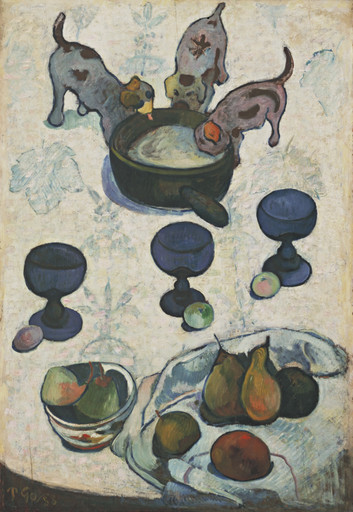
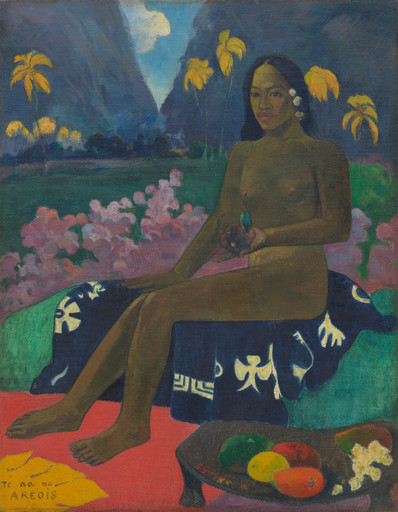
Along with his contemporaries Vincent van Gogh and Paul Cézanne , Paul Gauguin was a pioneer of modernist art. His use of expressive colors, flat planes, and simplified, distorted forms in paintings, as well as a rough, semi-abstract aesthetic in sculptures and woodcuts , exerted a profound influence on avant-garde artists in the early 20th century, from Henri Matisse and Pablo Picasso to the German Expressionists .

Learn more →
All works by Paul Gauguin →

Installation views

We have identified this work in the following photos from our exhibition history.

How we identified these works
In 2018–19, MoMA collaborated with Google Arts & Culture Lab on a project using machine learning to identify artworks in installation photos. That project has concluded, and works are now being identified by MoMA staff.

If you notice an error, please contact us at [email protected].
Licensing
To reproduce installation views, please contact Art Resource (publication in North America) or Scala Archives (publication in all other geographic locations). You will need to include the object identification number found in the caption.
Feedback
This record is a work in progress. If you have additional information or spotted an error, please send feedback to [email protected].

Licensing

Artwork or archival images

If you would like to reproduce an image of a work of art in MoMA's collection, or an image of a MoMA publication or archival material (including installation views, checklists, and press releases), please contact Art Resource (publication in North America) or Scala Archives (publication in all other geographic locations).

Audio and film clips

MoMA licenses archival audio and select out of copyright film clips from our film collection. At this time, MoMA produced video cannot be licensed by MoMA/Scala. All requests to license archival audio or out of copyright film clips should be addressed to Scala Archives at [email protected]. Motion picture film stills cannot be licensed by MoMA/Scala. For access to motion picture film stills for research purposes, please contact the Film Study Center at [email protected]. For more information about film loans and our Circulating Film and Video Library, please visit Circulating Film and Video Library.

Text from a publication or the archives

If you would like to reproduce text from a MoMA publication, please email [email protected]. If you would like to publish text from MoMA's archival materials, please fill out this permission form and send to [email protected].

Feedback

This record is a work in progress. If you have additional information or spotted an error, please fill out this feedback form.