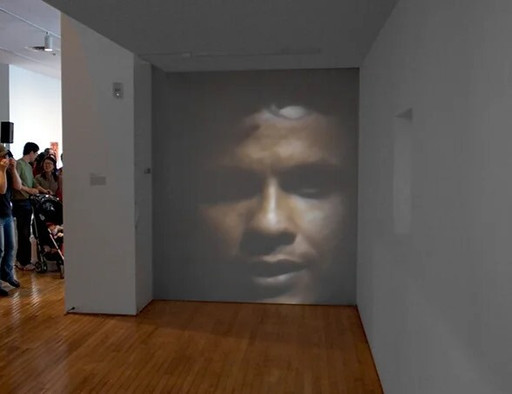
This video sculpture is titled after the writer Samuel Beckett’s 1965 text, which starkly contemplates confinement and the edges of reality. A monolithic cube, evoking Minimalist art of the 1960s and 1970s, is illuminated from within by projected images of a larger-than-life human head. The subject is gradually covered with organic substances in a cycle of desecration and renewal. In Judith Barry’s words, “Such waste drops so that I might live, until, from loss to loss...my entire body falls beyond the limit.”
The artist created this work in 1991, when major cultural and technological milestones—including the end of the Cold War and the launch of the World Wide Web—began to reshape public and private life. Through the conjunction of imagery and architecture, she explores the “translation into built form of our lived social relations.” Here, Barry contrasts visceral bodily experience with the sterile design of commercial spaces—like shopping malls or corporate plazas—and the alienating effect of mass media. In doing so, she illustrates how contemporary culture promotes representation over authenticity and transforms us into spectators of our own lives.
2026
Kids label from 2026
Drip, drop, drip, drop . . .
This cube shows videos of a person’s head getting covered in runny liquids and bugs. Move around the cube to see different sides of the head. You can also see your reflection in the mirrors along the cube’s base.
Imagine how it might feel if this were your head. What words would you use to describe the feeling?
2026
Explore more






Audio
Audio from the playlist 1980–Today: Works from the Collection
From MoMA Design Store


Licensing
Artwork or archival images
If you would like to reproduce an image of a work of art in MoMA's collection, or an image of a MoMA publication or archival material (including installation views, checklists, and press releases), please contact Art Resource (publication in North America) or Scala Archives (publication in all other geographic locations).
Audio and film clips
MoMA licenses archival audio and select out of copyright film clips from our film collection. At this time, MoMA produced video cannot be licensed by MoMA/Scala. All requests to license archival audio or out of copyright film clips should be addressed to Scala Archives at [email protected]. Motion picture film stills cannot be licensed by MoMA/Scala. For access to motion picture film stills for research purposes, please contact the Film Study Center at [email protected]. For more information about film loans and our Circulating Film and Video Library, please visit Circulating Film and Video Library.
Text from a publication or the archives
If you would like to reproduce text from a MoMA publication, please email [email protected]. If you would like to publish text from MoMA's archival materials, please fill out this permission form and send to [email protected].
Feedback
This record is a work in progress. If you have additional information or spotted an error, please fill out this feedback form.