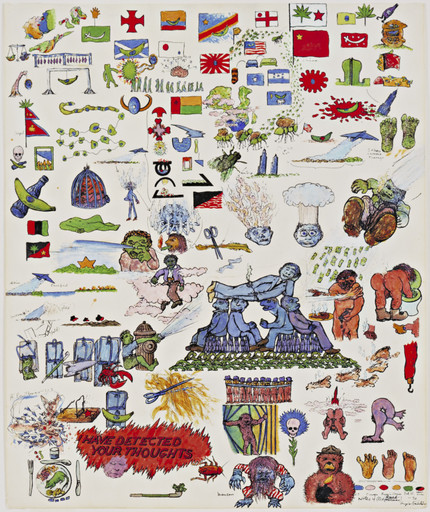
Dias occupies a central place in Brazilian art of the 1960s and 1970s. He left Brazil in 1966 and arrived in Paris in time to participate in the May 1968 protests. Because of his political involvement he was forced to move again; he settled in Milan, where he became the only Latin American member of the Arte Povera movement, whose adherents deployed common materials to counter art's increasing commodification. The Invented Country speaks to Dias's personal situation as well as to the political conditions of the moment. Produced while he was traveling in Nepal, the work was originally shown in an abandoned building in Milan that had been taken over by a commune of squatters. It suggests that, in the words of the artist, "ideology had gone fishing." Dias has presented the work as an emblem of failed state-sponsored revolutions and of the smaller utopian experiments that replaced them.
Transmissions: Art in Eastern Europe and Latin America, 1960–1980, September 5, 2015–January 3, 2016.
Explore more
From MoMA Design Store


Installation views
We have identified this work in the following photos from our exhibition history.
Licensing
Artwork or archival images
If you would like to reproduce an image of a work of art in MoMA's collection, or an image of a MoMA publication or archival material (including installation views, checklists, and press releases), please contact Art Resource (publication in North America) or Scala Archives (publication in all other geographic locations).
Audio and film clips
MoMA licenses archival audio and select out of copyright film clips from our film collection. At this time, MoMA produced video cannot be licensed by MoMA/Scala. All requests to license archival audio or out of copyright film clips should be addressed to Scala Archives at [email protected]. Motion picture film stills cannot be licensed by MoMA/Scala. For access to motion picture film stills for research purposes, please contact the Film Study Center at [email protected]. For more information about film loans and our Circulating Film and Video Library, please visit Circulating Film and Video Library.
Text from a publication or the archives
If you would like to reproduce text from a MoMA publication, please email [email protected]. If you would like to publish text from MoMA's archival materials, please fill out this permission form and send to [email protected].
Feedback
This record is a work in progress. If you have additional information or spotted an error, please fill out this feedback form.