Standard-definition video (black and white, sound)
Not on view
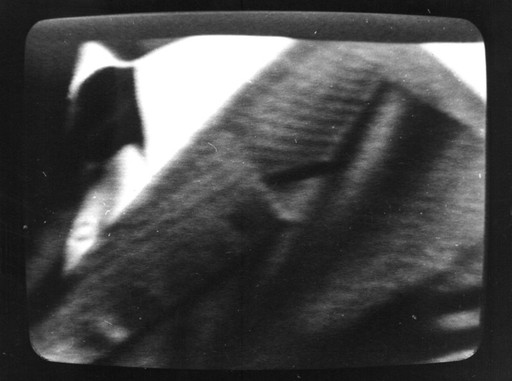
In this work, Iveković stares into the video camera and uses its lens as a mirror as she methodically draws arrows in black ink on her face and neck. Negating the everyday ritual of applying makeup, the artist mocks the “how-to” language of advertising with stoic intensity, evoking instead the application of war paint. When she attempts to rub the ink away—or massage it into her skin—it leaves behind a smeared, grimy residue. The work is both a comment on the unrealistic standards of feminine beauty enforced by mass media and a protest against the systematic implementation
of gender codes in consumer society.
Iveković began her art career in the late 1960s at the height of the Croatian Spring, a cultural revolution propelled by calls for social, political, and economic reform, during which many artists and thinkers began making work in direct opposition to mainstream institutional norms and state-sanctioned art. Part of a generation of artists in the former Yugoslavia known as the Nova Umjetnička Praksa, or New Art Practice, Iveković has employed conceptual photomontage, video, performance, and public art to critically analyze the politics of power and transcend cultural boundaries. Iveković is known as the first artist to publicly identify as feminist in Croatia, in what she has described as “a gesture of disobedience toward the Communist regime that treated feminism as a bourgeois import from the West.”
MoMA Highlights: 375 Works from The Museum of Modern Art, New York (New York: The Museum of Modern Art, 2019)
Explore more



From MoMA Design Store


Licensing
Artwork or archival images
If you would like to reproduce an image of a work of art in MoMA's collection, or an image of a MoMA publication or archival material (including installation views, checklists, and press releases), please contact Art Resource (publication in North America) or Scala Archives (publication in all other geographic locations).
Audio and film clips
MoMA licenses archival audio and select out of copyright film clips from our film collection. At this time, MoMA produced video cannot be licensed by MoMA/Scala. All requests to license archival audio or out of copyright film clips should be addressed to Scala Archives at [email protected]. Motion picture film stills cannot be licensed by MoMA/Scala. For access to motion picture film stills for research purposes, please contact the Film Study Center at [email protected]. For more information about film loans and our Circulating Film and Video Library, please visit Circulating Film and Video Library.
Text from a publication or the archives
If you would like to reproduce text from a MoMA publication, please email [email protected]. If you would like to publish text from MoMA's archival materials, please fill out this permission form and send to [email protected].
Feedback
This record is a work in progress. If you have additional information or spotted an error, please fill out this feedback form.