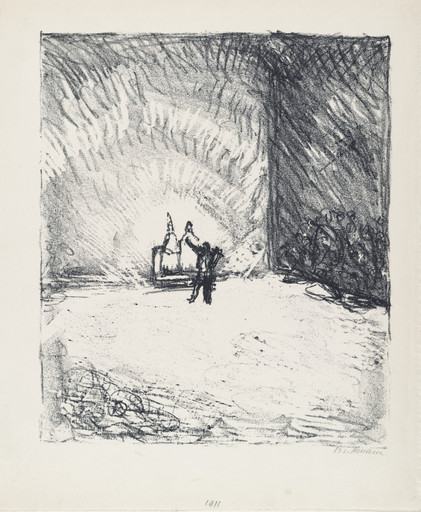
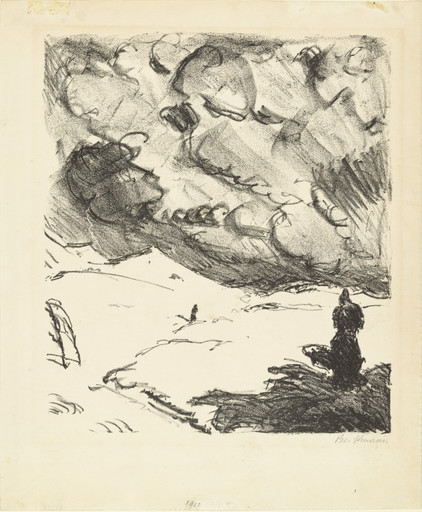
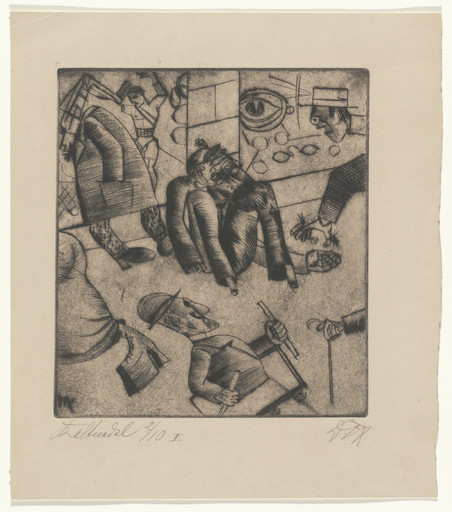
In six penetrating drypoints, Beckmann drew out the conflicting emotions underlying his first play, Ebbi, which he described as a "modern Hamlet." The sharply rendered comedic scenes and absurdist hallucinations express his simultaneous disdain and desire for the comforts of middle-class life.
Bored and restless, Eberhard Kautsch (Ebbi) yearns to become a poet and lead a life unencumbered by his dull family, the daily drudgery of office work, and hemorrhoids. Johanna Löffel, a seductive young painter, spirits him away to a cheap brothel, where his impotence mirrors his inability to overcome conventional morality. There they meet a thug recently released from jail, Jakob Nipsel, whom Beckmann modeled on himself in the illustrations. A wild night of cocaine-induced hallucinations follows. The trio then breaks into the apartment of Ebbi's nouveau-riche friends. Realizing he cannot stomach robbery and murder, Ebbi saves the doorman from Nipsel's violence and returns, a hero, to bourgeois life.
In addition to Ebbi, Beckmann wrote two other plays, neither of which was a theatrical success. Ebbi itself was not performed until 1980. After Beckmann's frequent publisher Reinhard Piper declined to publish the play, Otto Nirenstein agreed to issue a small edition of thirty-three copies through his Johannes-Presse in 1924, and commissioned the illustrations from the artist.
Heather Hess, German Expressionist Digital Archive Project, German Expressionism: Works from the Collection. 2011.
Explore more
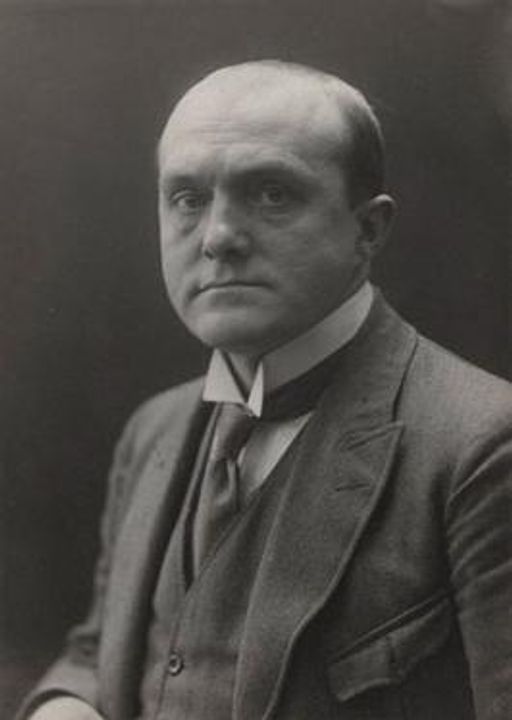
Max Beckmann
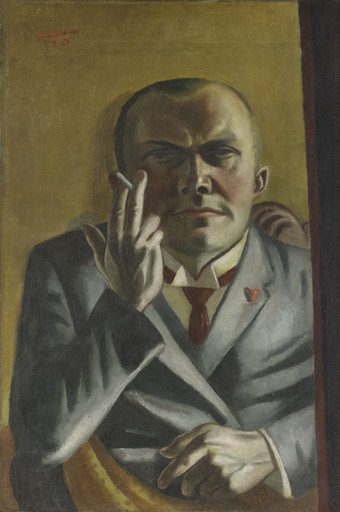
German, 1884–1950 218 works onlineMax Beckmann dreamed up a world of actors, cabaret singers, heroes, and thugs, whose dramas unfold on city streets, at masquerades and carnivals, and in candlelit chambers.
Learn more →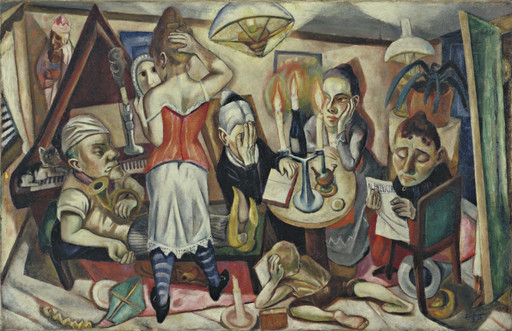

From MoMA Design Store


Licensing
Artwork or archival images
If you would like to reproduce an image of a work of art in MoMA's collection, or an image of a MoMA publication or archival material (including installation views, checklists, and press releases), please contact Art Resource (publication in North America) or Scala Archives (publication in all other geographic locations).
Audio and film clips
MoMA licenses archival audio and select out of copyright film clips from our film collection. At this time, MoMA produced video cannot be licensed by MoMA/Scala. All requests to license archival audio or out of copyright film clips should be addressed to Scala Archives at [email protected]. Motion picture film stills cannot be licensed by MoMA/Scala. For access to motion picture film stills for research purposes, please contact the Film Study Center at [email protected]. For more information about film loans and our Circulating Film and Video Library, please visit Circulating Film and Video Library.
Text from a publication or the archives
If you would like to reproduce text from a MoMA publication, please email [email protected]. If you would like to publish text from MoMA's archival materials, please fill out this permission form and send to [email protected].
Feedback
This record is a work in progress. If you have additional information or spotted an error, please fill out this feedback form.