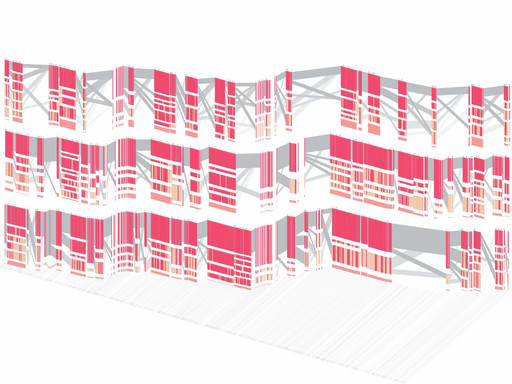
Fry’s Distellamap is a visualization of the code and data found in a Pac-Man Atari 2600 cartridge, highlighting not only the mathematical instructions, but also the commands that direct jumps to different locations in the program. The project, Fry has explained, is based on “columns of assembly language, most of it either math or conditional statements (if x is true, go to y). Each time there is a ‘go to’ instruction, a curve is drawn from that point to its destination. When a byte of data (as opposed to code) is found in the cartridge, it is shown as an orange row: a solid block for a ‘1’ or a dot for a ‘0.’” Fry’s intent is not to analyze the software but rather to celebrate its elegance with an equally graceful portrait. Distellamap was designed using Processing, an open-source programming language and integrated development environment based on Java language, devised by Fry and Casey Reas. Simple enough to be picked up by nonprogrammers and sophisticated enough to be used for high-level design, architecture, visualization, and animation projects, Processing has had a significant impact as a powerful and inspiring design tool.
Applied Design, March 2, 2013–January 31, 2014.
Explore more
Coding/programming
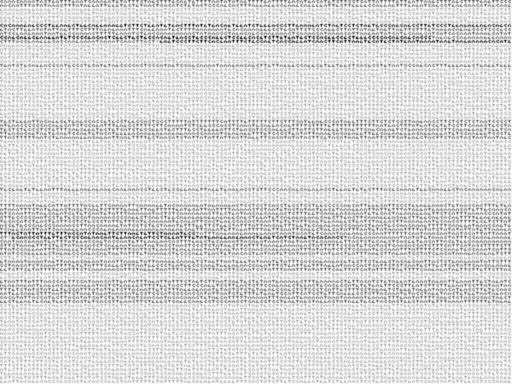
Coding is the method by which computer programmers, or coders, transmit instructions to computers. Coding transforms human language into the binary language of computers (in which there are only two possible states, off and on, commonly symbolized by 0 and 1).
Learn more →


From MoMA Design Store


Installation views
We have identified this work in the following photos from our exhibition history.
Licensing
Artwork or archival images
If you would like to reproduce an image of a work of art in MoMA's collection, or an image of a MoMA publication or archival material (including installation views, checklists, and press releases), please contact Art Resource (publication in North America) or Scala Archives (publication in all other geographic locations).
Audio and film clips
MoMA licenses archival audio and select out of copyright film clips from our film collection. At this time, MoMA produced video cannot be licensed by MoMA/Scala. All requests to license archival audio or out of copyright film clips should be addressed to Scala Archives at [email protected]. Motion picture film stills cannot be licensed by MoMA/Scala. For access to motion picture film stills for research purposes, please contact the Film Study Center at [email protected]. For more information about film loans and our Circulating Film and Video Library, please visit Circulating Film and Video Library.
Text from a publication or the archives
If you would like to reproduce text from a MoMA publication, please email [email protected]. If you would like to publish text from MoMA's archival materials, please fill out this permission form and send to [email protected].
Feedback
This record is a work in progress. If you have additional information or spotted an error, please fill out this feedback form.