Ben Fry, Aesthetics + Computation Group, MIT Media Laboratory
Genomic Cartography: Chromosome 18
2001
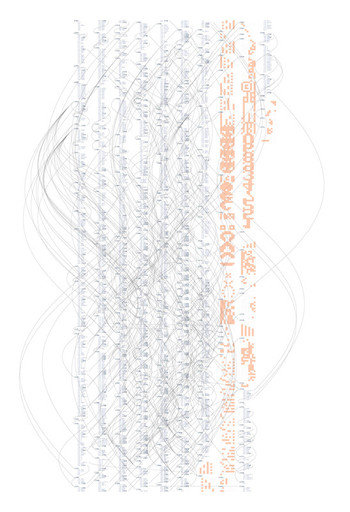
Digital image generated from processing software
While pursuing his doctorate with the Aesthetics + Computation Group at the MIT Media Lab, Fry—a central figure in the field of information and data visualization—devoted himself to translating information about the human genome into a visual format. The genome, a complete set of genetic instructions, consists of 23 chromosome pairs made up of DNA, which is built from four chemical bases, represented by the letters A, G, C, and T. The entire human genome’s genetic code comprises more than three billion letters. In this translation of chromosome 18’s seventy-five million letters of genetic code, darker colors depict code sequences used by a cell as instructions for building a protein; medium tones depict the instructions interrupted by unused code; and gray areas currently have no known function.
Pirouette: Turning Points in Design, January 26, 2025–November 15, 2025
Gallery label from Design and the Elastic Mind , February 24–May 12, 2008
For several years while pursuing his doctorate at the MIT Media Lab, Fry devoted his work to the visual translation of genomic findings. Several of his works are on view here, but it is apt to begin with one of his most encompassing and ambitious projects, the seventy million letters of genetic code that form chromosome 18. The darker color depicts sequences of code that are used by a cell as a set of instructions for building a protein. These instructions are interrupted by unused pieces of code, which have a medium tone in the image. The gray areas currently have no known function. At seventy-five million DNA bases (each represented by one of four letters), this is the sixth shortest human chromosome. It would take forty- five images of this size to depict the genetic code of the entire human genome, more than three billion letters.
Design and the Elastic Mind, February 24–May 12, 2008
Explore more
Coding/programming
Coding is the method by which computer programmers, or coders, transmit instructions to computers. Coding transforms human language into the binary language of computers (in which there are only two possible states, off and on, commonly symbolized by 0 and 1).
Learn more →
The Edge of Information Design
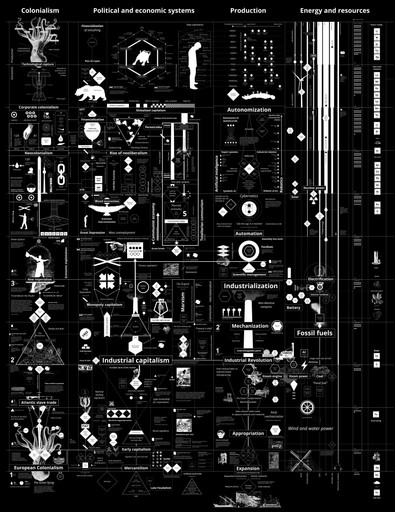
1 SouthWe swim in an ocean of data. Every click, weather pattern, border crossing, and blood test is tracked and fed into systems that increasingly inform our daily behaviors. Data, however, is not knowledge.
Learn more →


From MoMA Design Store


Licensing
Artwork or archival images
If you would like to reproduce an image of a work of art in MoMA's collection, or an image of a MoMA publication or archival material (including installation views, checklists, and press releases), please contact Art Resource (publication in North America) or Scala Archives (publication in all other geographic locations).
Audio and film clips
MoMA licenses archival audio and select out of copyright film clips from our film collection. At this time, MoMA produced video cannot be licensed by MoMA/Scala. All requests to license archival audio or out of copyright film clips should be addressed to Scala Archives at [email protected]. Motion picture film stills cannot be licensed by MoMA/Scala. For access to motion picture film stills for research purposes, please contact the Film Study Center at [email protected]. For more information about film loans and our Circulating Film and Video Library, please visit Circulating Film and Video Library.
Text from a publication or the archives
If you would like to reproduce text from a MoMA publication, please email [email protected]. If you would like to publish text from MoMA's archival materials, please fill out this permission form and send to [email protected].
Feedback
This record is a work in progress. If you have additional information or spotted an error, please fill out this feedback form.