Not on view
Cedric Price came on to the British architectural scene in the late 1950s, a time in which housing complexes, schools, industrial parks and new towns were springing up all over Britain. There was an overriding belief in a socially responsibly architecture and general feeling of optimism about the future and architecture's capacity to improve the environment. Price, however, was determined that his work would not impose physical or psychological constraints upon its occupants nor reduce them to standards, as did modernist architecture. Through the pairing of humor and playfulness with complete conviction, Price's projects all attest to his belief in an architecture that provides inhabitants as well as viewers individual freedoms. Technology, based on the paradigm of a flexible network rather than a static structure, played an essential role in Price's work.
an essay by Bevin Cline and Tina di Carlo, in Terence Riley, ed., The Changing of the Avant-Garde: Visionary Architectural Drawings from the Howard Gilman Collection, New York: The Museum of Modern Art, 2002.
Architectural drawings have a variety of uses: to instruct, inform, indulge, confuse, confirm, congratulate, and console. –Cedric Price
Cedric Price belonged to a 1950s generation of British architects and educators who were intensely concerned with an architecture of the future at the same time that they saw architecture as the ultimate social art. Price's personal vision of the city, then, was inventive and current while also expressing his sense of architecture's moral obligations: fascinated by new technology, he also believed that its use must be appropriate, playing a role in society that would serve the public and further its freedom and flexibility rather than confining them. His ideas were visionary but were grounded in the realization that architecture must work for all people.
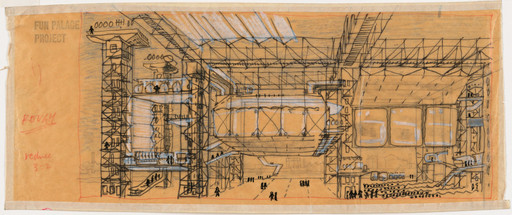
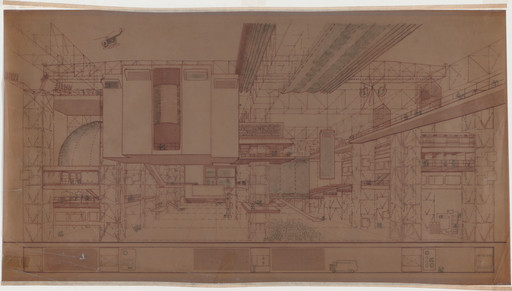
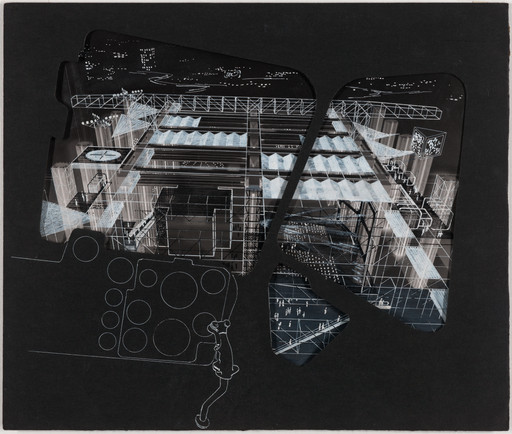
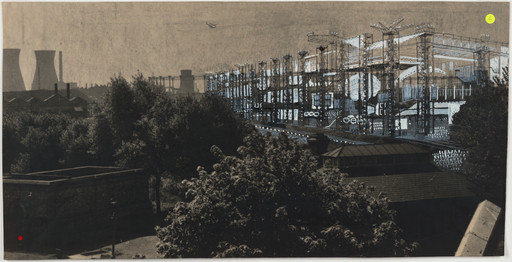
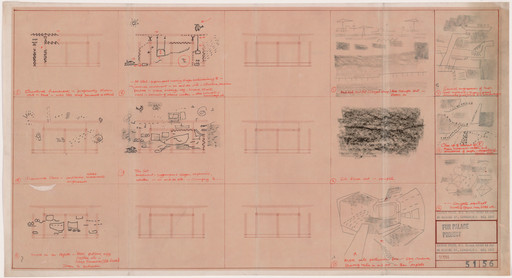
This drawing for a City of the Future comprises fourteen vignettelike perspectives, with accompanying texts, which together can be considered a summary of ideas about the city that Price had presented in more detail in earlier projects. One of his principles was that the elements that make up the city, such as buildings and service devices, must respond to the user automatically. Essentially he was calling for a form of artificial intelligence, an idea he had developed in his Pottery Thinkbelt Project of 1963, an unconventional higher–education facility that, if built, would have been located in a depressed industrial area. He also refuted the ancient assumption that buildings are stationary, suggesting instead that buildings of the modern age could move. The traveling gantry crane and suspended rooms and walkways that he had worked out in his Fun Palace Project of 1960-61 reappear in more general terms in the City of the Future through the description, "the potential of phased movement of goods, shelters and equipment by means of mechanical and magnetic suspension."
Matilda McQuaid, ed., Envisioning Architecture: Drawings from The Museum of Modern Art, New York: The Museum of Modern Art, 2002, p. 144.
Explore more

From MoMA Design Store


Licensing
Artwork or archival images
If you would like to reproduce an image of a work of art in MoMA's collection, or an image of a MoMA publication or archival material (including installation views, checklists, and press releases), please contact Art Resource (publication in North America) or Scala Archives (publication in all other geographic locations).
Audio and film clips
MoMA licenses archival audio and select out of copyright film clips from our film collection. At this time, MoMA produced video cannot be licensed by MoMA/Scala. All requests to license archival audio or out of copyright film clips should be addressed to Scala Archives at [email protected]. Motion picture film stills cannot be licensed by MoMA/Scala. For access to motion picture film stills for research purposes, please contact the Film Study Center at [email protected]. For more information about film loans and our Circulating Film and Video Library, please visit Circulating Film and Video Library.
Text from a publication or the archives
If you would like to reproduce text from a MoMA publication, please email [email protected]. If you would like to publish text from MoMA's archival materials, please fill out this permission form and send to [email protected].
Feedback
This record is a work in progress. If you have additional information or spotted an error, please fill out this feedback form.