Cedric Price
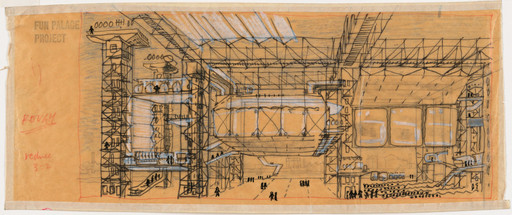
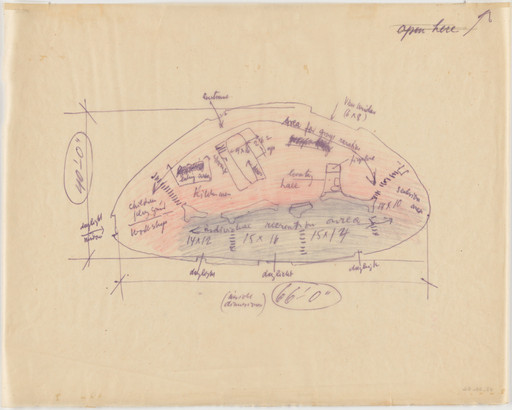
Fun Palace for Joan Littlewood Project, Stratford East, London, England (Perspective)
1959–1961
Ink, crayon, and graphite on gelatin silver print, with self-adhesive paper dot
Not on view
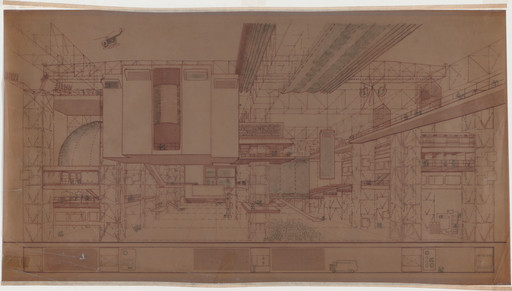
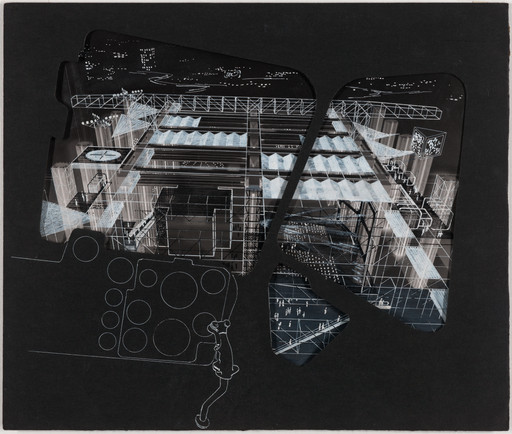
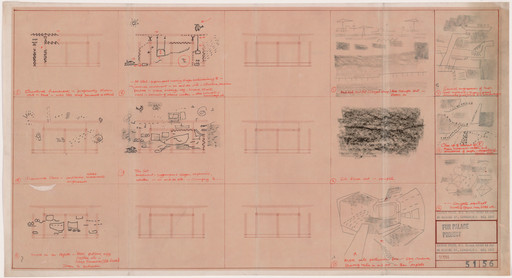
Fun Palace for Joan Littlewood was conceived for the East End of London as a "laboratory of fun" and "a university of the streets." Although it was never realized, unlike other visionary projects of the 1960s it was fully intended to be built. Designed as a flexible framework into which programmable spaces can be plugged, the structure has as its ultimate goal the possibility of change at the behest of its users. Price belonged to a generation of British architects and educators who used architecture both to address the future and as the ultimate social art. Price's personal vision of the city was inventive and playful and expressed his sense of architecture’s moral obligations toward its users. Price was fascinated by new technology and believed that it should both serve the public and further human freedom. He was determined that his work would not impose physical or psychological constraints upon its occupants nor reduce them to a standard form—unlike typical modern architecture.
9 + 1 Ways of Being Political: 50 Years of Political Stances in Architecture and Urban Design, September 12, 2012–March 25, 2013.
Publication excerpt from an essay by Bevin Cline and Tina di Carlo, in Terence Riley, ed., The Changing of the Avant-Garde: Visionary Architectural Drawings from the Howard Gilman Collection , New York: The Museum of Modern Art, 2002, p. 44.
The Fun Palace was commissioned by Joan Littlewood, founder of the Theater Workshop at the Theater Royal, Isle of Dogs, in the East End of London. Price's first large-scale project was to be a "laboratory of fun" and "a university of the streets," as its patron described it. Inspired by a fascination with technology, Price planned for an open steel-gridded structure that could support a completely flexible program. Hanging rooms for dancing, music, and drama; mobile floors, walls, ceilings, and walkways; and advanced temperature systems that could disperse and control fog, warm air, and moisture were all intended to promote active "fun."
an essay by Bevin Cline and Tina di Carlo, in Terence Riley, ed., The Changing of the Avant-Garde: Visionary Architectural Drawings from the Howard Gilman Collection, New York: The Museum of Modern Art, 2002, p. 44.
Publication excerpt from an essay by Bevin Cline and Tina di Carlo, in Terence Riley, ed., The Changing of the Avant-Garde: Visionary Architectural Drawings from the Howard Gilman Collection , New York: The Museum of Modern Art, 2002, p. 56.
Cedric Price came on to the British architectural scene in the late 1950s, a time in which housing complexes, schools, industrial parks and new towns were springing up all over Britain. There was an overriding belief in a socially responsibly architecture and general feeling of optimism about the future and architecture's capacity to improve the environment. Price, however, was determined that his work would not impose physical or psychological constraints upon its occupants nor reduce them to standards, as did modernist architecture. Through the pairing of humor and playfulness with complete conviction, Price's projects all attest to his belief in an architecture that provides inhabitants as well as viewers individual freedoms. Technology, based on the paradigm of a flexible network rather than a static structure, played an essential role in Price's work.
an essay by Bevin Cline and Tina di Carlo, in Terence Riley, ed., The Changing of the Avant-Garde: Visionary Architectural Drawings from the Howard Gilman Collection, New York: The Museum of Modern Art, 2002, p. 56.
Explore more

From MoMA Design Store


Installation views
We have identified this work in the following photos from our exhibition history.
Licensing
Artwork or archival images
If you would like to reproduce an image of a work of art in MoMA's collection, or an image of a MoMA publication or archival material (including installation views, checklists, and press releases), please contact Art Resource (publication in North America) or Scala Archives (publication in all other geographic locations).
Audio and film clips
MoMA licenses archival audio and select out of copyright film clips from our film collection. At this time, MoMA produced video cannot be licensed by MoMA/Scala. All requests to license archival audio or out of copyright film clips should be addressed to Scala Archives at [email protected]. Motion picture film stills cannot be licensed by MoMA/Scala. For access to motion picture film stills for research purposes, please contact the Film Study Center at [email protected]. For more information about film loans and our Circulating Film and Video Library, please visit Circulating Film and Video Library.
Text from a publication or the archives
If you would like to reproduce text from a MoMA publication, please email [email protected]. If you would like to publish text from MoMA's archival materials, please fill out this permission form and send to [email protected].
Feedback
This record is a work in progress. If you have additional information or spotted an error, please fill out this feedback form.