Ludwig Mies van der Rohe
German Pavilion, International Exposition, Barcelona, Spain, Floor plan, second preliminary scheme
1928-29
Pencil and colored pencil on tracing paper
Not on view
Late in 1928, Mies van der Rohe began to design the pavilion that would represent Germany at the 1929 Barcelona International Exposition, the first such event in which the country had participated since its defeat in World War I. The democratically elected postwar government had made its aspirations for the pavilion clear: the building was to represent "our desire to be absolutely truthful, giving voice to the spirit of a new era." The state made few other demands, leaving Mies free to pursue his most radical architectural expression of free-flowing space, bounded only by rich but abstract surfaces of Tinian marble, mirror chrome, plate glass, and onyx.
Since the pavilion was demolished when the fair was over, relatively few later audiences and architectural critics had ever seen the building except through the filter of period black-and-white photographs, and its significance became largely a matter of thirdhand debate rather than actual experience. In time it came to be interpreted in terms of Mies's later, more rational work of the 1940s and later, often derided as simple "glass boxes".
an essay by Terence Riley, in Matilda McQuaid, ed., Envisioning Architecture: Drawings from The Museum of Modern Art, New York: The Museum of Modern Art, 2002, p. 70.
Explore more
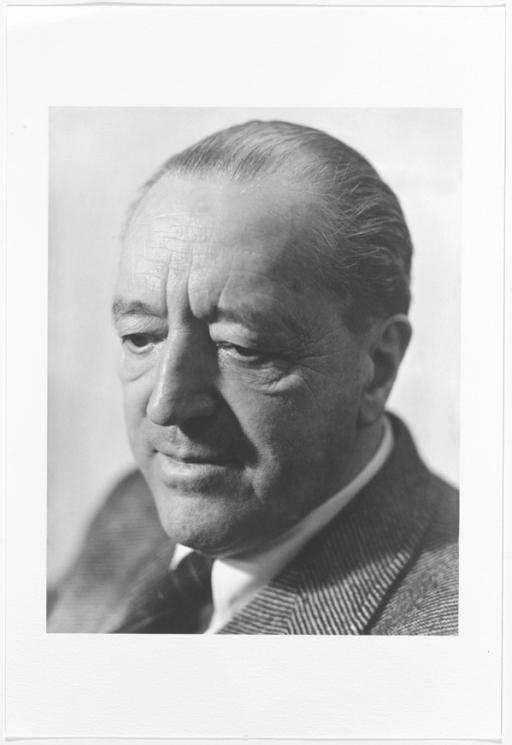
Ludwig Mies van der Rohe
American, born Germany. 1886–1969 2069 works onlineOne of the leading lights of modernist architecture, Ludwig Mies van der Rohe created a body of work—ranging from tubular steel furniture to iconic office buildings—that influenced generations of architects worldwide.
Learn more →


From MoMA Design Store


Licensing
Artwork or archival images
If you would like to reproduce an image of a work of art in MoMA's collection, or an image of a MoMA publication or archival material (including installation views, checklists, and press releases), please contact Art Resource (publication in North America) or Scala Archives (publication in all other geographic locations).
Audio and film clips
MoMA licenses archival audio and select out of copyright film clips from our film collection. At this time, MoMA produced video cannot be licensed by MoMA/Scala. All requests to license archival audio or out of copyright film clips should be addressed to Scala Archives at [email protected]. Motion picture film stills cannot be licensed by MoMA/Scala. For access to motion picture film stills for research purposes, please contact the Film Study Center at [email protected]. For more information about film loans and our Circulating Film and Video Library, please visit Circulating Film and Video Library.
Text from a publication or the archives
If you would like to reproduce text from a MoMA publication, please email [email protected]. If you would like to publish text from MoMA's archival materials, please fill out this permission form and send to [email protected].
Feedback
This record is a work in progress. If you have additional information or spotted an error, please fill out this feedback form.