Since the 1990s, artist Teresa Margolles has used physical traces of violence to create her politically engaged art. Drawing on the interconnected histories of the United States and Mexico, and techniques she learned while working for Mexico’s national forensic service, she gathers remnants from sites of loss and death: glass shattered by shootings, blood, soil, and architectural fragments. With these charged materials, she makes visible structural violence connected to migration crises, drug wars, and the systemic killing of women and girls, honoring those who have been erased from public memory.
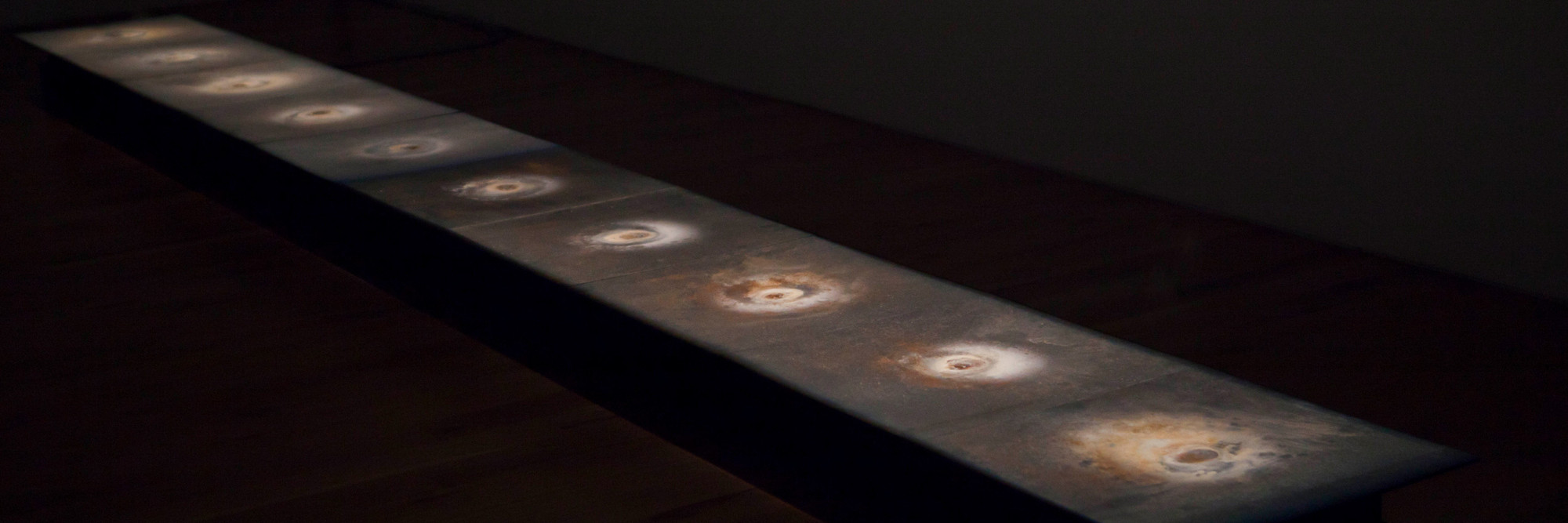
Aproximación al lugar de los hechos (Approaching the Scene) focuses on recent incidents in Minnesota, California, and Texas. The installation combines heated metal plates and water infused with residue that the artist has collected from places where people have been murdered in those states. Drops fall on the plates at steady intervals, creating a sharp hissing sound and rising steam. Over time, the plates rust, part of a rhythmic cycle of evaporation, erosion, and disappearance. Activating physical traces of violence, the installation creates a space for contemplation and public dialogue about how these crimes affect us all. As Margolles has said, “One murder changes the world.”
Desde la década de 1990, la artista Teresa Margolles ha utilizado rastros materiales de violencia para crear un arte comprometido políticamente. A partir de las técnicas que adquirió durante su período de trabajo en el servicio forense nacional mexicano y de las historias interconectadas de México y Estados Unidos, Margolles reúne restos de sitios marcados por la pérdida y la muerte: vidrios destrozados en tiroteos, sangre, tierra y fragmentos arquitectónicos. Mediante estos materiales cargados de significado, la artista hace visible la violencia estructural relacionada con las crisis migratorias, la guerra del narco y los sistémicos femicidios, rindiendo homenaje a las personas que han sido borradas de la memoria pública.
Aproximación al lugar de los hechos (At the Scene) se centra en incidentes recientes ocurridos en Minnesota, California y Texas. La instalación combina placas metálicas calientes y agua impregnada de residuos recolectados en los lugares donde ocurrieron los asesinatos. Las gotas de agua caen sobre las placas a intervalos regulares, produciendo un siseo agudo y un vapor visible que asciende. Con el tiempo, las placas se oxidan, como parte de un ciclo rítmico de evaporación, erosión y desaparición. Al activar los restos materiales de la violencia, la instalación crea un espacio para la reflexión y el diálogo público en torno a cómo estos crímenes nos afectan a todos. En palabras de Margolles, “un asesinato cambia el mundo”.
Presented in conjunction with the exhibition Teresa Margolles: En el lugar de los hechos (At the Scene) at MoMA PS1. This dual presentation is co-organized by MoMA PS1 and The Museum of Modern Art by Ana Janevski, Curator, Department of Media and Performance, and Inés Katzenstein, Curator of Latin American Art and Director of the Cisneros Institute, MoMA, with Chloë Courtney, Curatorial Assistant, and Julia Detchon, Former Curatorial Associate, Department of Drawings and Prints, MoMA.
La propuesta acompaña la exposición Teresa Margolles: En el lugar de los hechos (At the Scene) que tiene lugar en el MoMA PS1. Se trata de una doble presentación coorganizada por el MoMA PS1 y el Museum of Modern Art, a cargo de Ana Janevski, curadora del Department of Media and Performance, e Inés Katzenstein, curadora de Latin American Art y directora del Cisneros Institute at the Museum of Modern Art, junto con Chloë Courtney, asistente de curaduría del Department of Drawings y Prints, y Julia Detchon, ex curadora asociada del mismo departamento.