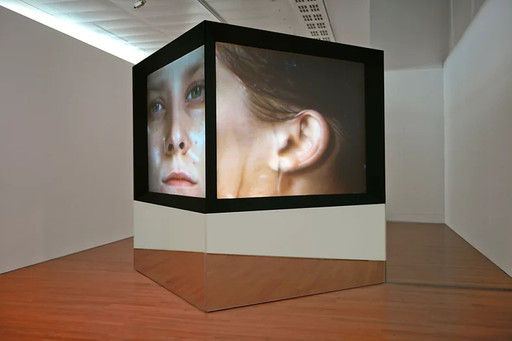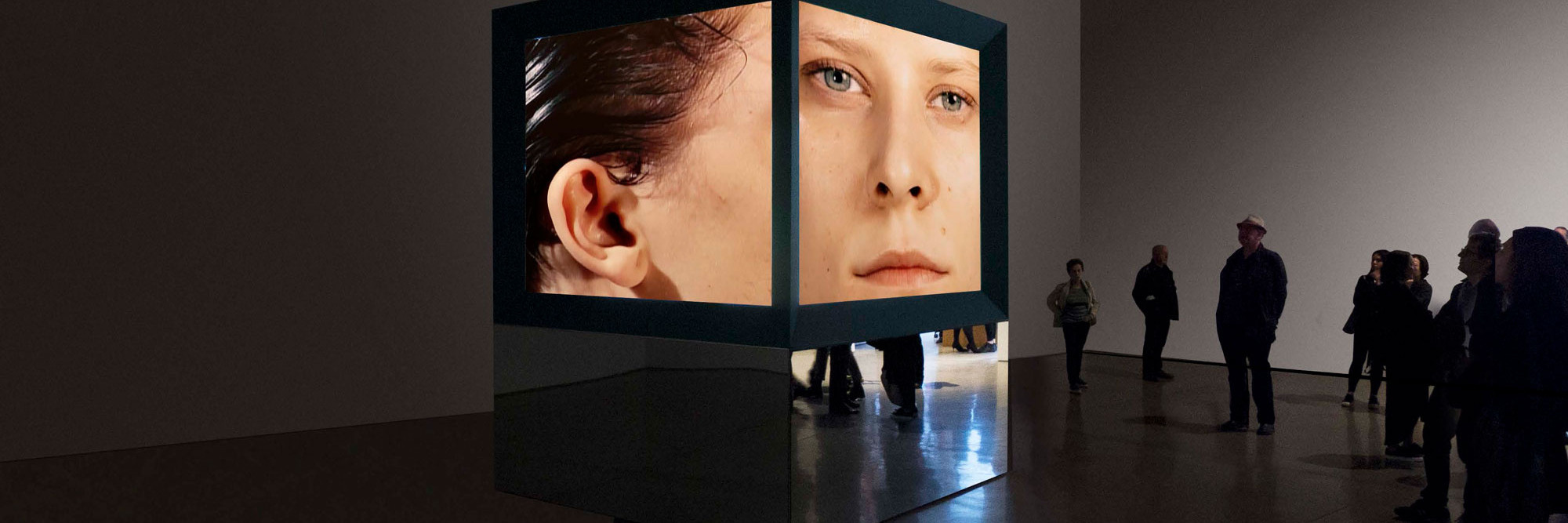
This video sculpture is titled after the writer Samuel Beckett’s 1965 text, which starkly contemplates confinement and the edges of reality. A monolithic cube, evoking Minimalist art of the 1960s and 1970s, is illuminated from within by projected images of a larger-than-life human head. The subject is gradually covered with organic substances in a cycle of desecration and renewal. In Judith Barry’s words, “Such waste drops so that I might live, until, from loss to loss...my entire body falls beyond the limit.”
The artist created this work in 1991, when major cultural and technological milestones—including the end of the Cold War and the launch of the World Wide Web—began to reshape public and private life. Through the conjunction of imagery and architecture, she explores the “translation into built form of our lived social relations.” Here, Barry contrasts visceral bodily experience with the sterile design of commercial spaces—like shopping malls or corporate plazas—and the alienating effect of mass media. In doing so, she illustrates how contemporary culture promotes representation over authenticity and transforms us into spectators of our own lives.
Please note: This video installation contains imagery of a performer being covered with liquids and edible insects. An alternate route is available through Gallery 216.
Organized by Erica Papernik-Shimizu, Associate Curator, Department of Media and Performance, with Abby Hermosilla, Curatorial Assistant, Department of Curatorial Affairs.