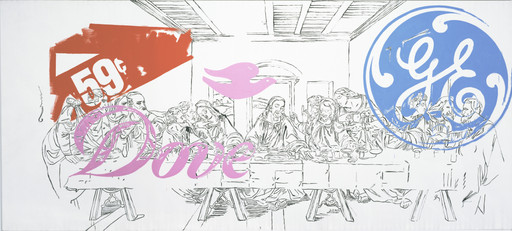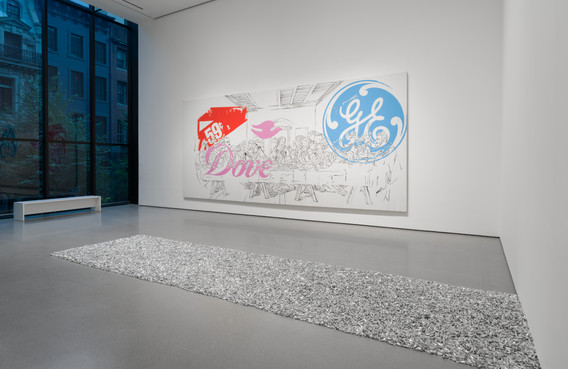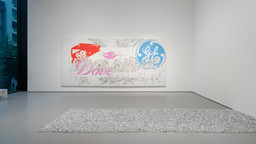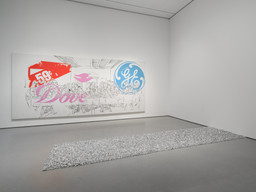
In the 1980s and ’90s, explosive public debates occurred around faith, desire, and moral authority. The era was marked by the AIDS crisis, during which stigmatization fueled by cultural leaders and government inaction resulted in widespread death. In this context of systemic neglect and loss, Andy Warhol and Felix Gonzalez-Torres produced the two works in this gallery, which reflect on mortality and morality while evading singular interpretation.
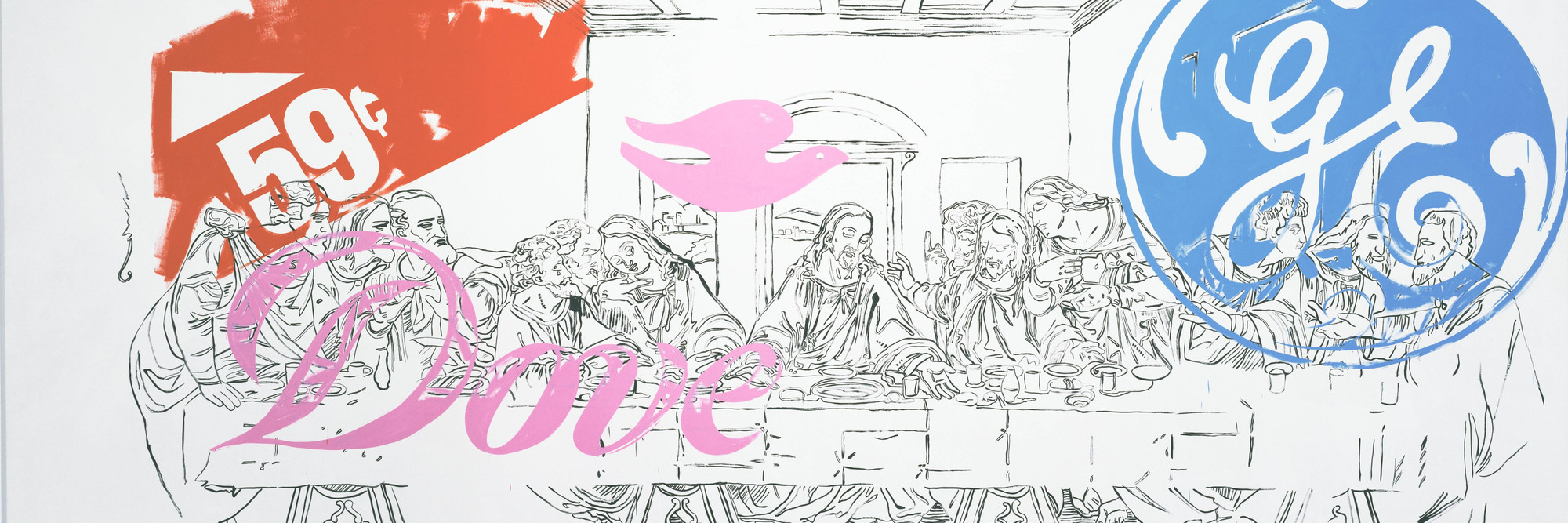
In The Last Supper, Warhol overlays corporate logos on the widely reproduced Leonardo da Vinci painting, situating the story of Christ’s betrayal and the origin of the Eucharist—a ritual in which bread substitutes the flesh of Jesus—within a contemporary culture of consumerism. Gonzalez-Torres created “Untitled” (Placebo) the year his partner, Ross Laycock, died of AIDS-related complications. The work may comprise thousands of pieces of candy; visitors can choose to take one each. The candy may be replenished, so that the work is perpetually in a cycle of diminishment and renewal. “I made the work almost...as a metaphor about disappearing,” Gonzalez-Torres said. “It doesn’t exist, even before it’s made, so you can’t kill it.”
Organized by Mia Matthias, Assistant Curator, Department of Painting and Sculpture, with Abby Hermosilla, Curatorial Assistant, Department of Curatorial Affairs.