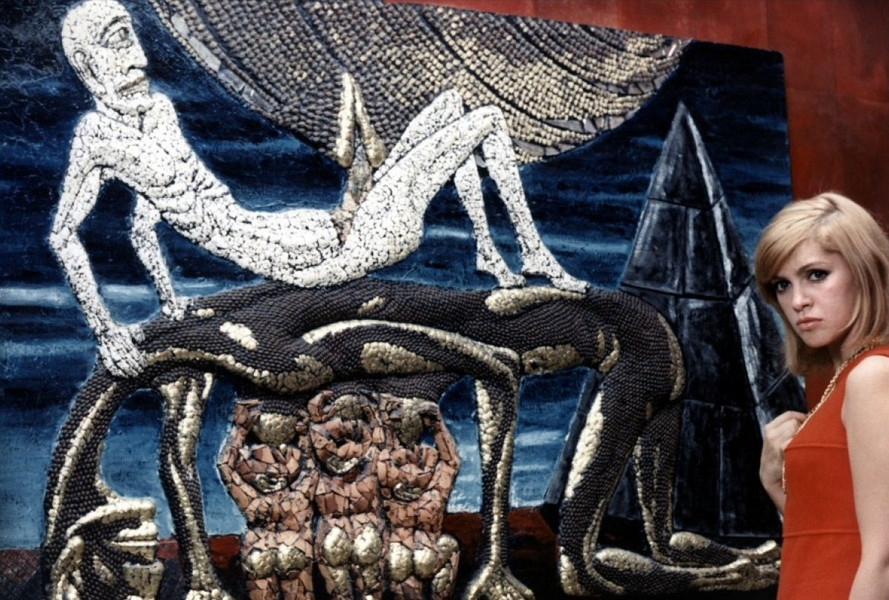
The human stain of treachery, cowardice, and deceit—a creeping moral and physical sickness—pervades the films of French screenwriter and director Henri-Georges Clouzot (1907–1977). Jealous husbands and wives concoct elaborate schemes to do each other in. Neighbors spy on fellow neighbors and rat one another out. All have their secret lives laid bare before a ravenous and contemptuous public, whether in the boarding house, the school, the sanitarium, the courtroom, or the petty, hateful little village. Like Lang, Hitchcock, and Chabrol, the filmmakers with whom he is most often compared, Clouzot eroticizes man’s murderous instincts and takes perverse delight in implicating his audience. Unlike Hitchcock, however, order is rarely restored when sin, injustice, and faithlessness bring earthly misery. As this comprehensive retrospective amply demonstrates, Clouzot’s was not a “cinema of quality,” as the French New Wave critics unjustly derided, but rather a “cinema of cruelty,” to which Franju, Polanski, Kubrick, and Haneke also belong.
Controversy trailed Clouzot throughout his career. His masterful breakthrough feature Le Corbeau (The Raven) (1943), made for the Nazi-stooge company Continental Films, was attacked on all sides—the right-wing Vichy regime, the left-wing Resistance press, and the Catholic Church—and though Sartre and Cocteau came to his defense, Clouzot was banned for several years after Liberation from making another film. François Truffaut would later describe Le Corbeau as “a fairly accurate picture of what I had seen around me during the war and the postwar period—collaboration, denunciation, the black market, hustling."
Pleasure comes from inflicting pain, whether in the squalid, perfidious love triangles (and quadrilaterals) of Quai des Orfèvres (1947), Diabolique (1955), La Vérité (1960), and La Prisonnière (1968), or in a concentration camp survivor’s interrogation and torture of a wounded Nazi war criminal in "Retour de Jean," an episode of the postwar omnibus film Return to Life (1949).
But Clouzot’s characters, particularly his women, are never without sympathy. In Manon (1949), his morally shaded postwar adaptation of l’Abbé Prévost’s Manon Lescault (the novel on which Puccini’s opera was also based), the film’s cunning young prostitute is branded a collaborator and greedy opportunist, but she takes a former Resistance fighter as her lover. In La Vérité, the trial of Dominique Marceau (Brigitte Bardot, in an affecting performance) for the murder of her former lover becomes an assassination of her character, casting a harsh light on the hypocrisy and cruelty of male-dominated society.
While at the peak of their careers, Clouzot beat out Hitchcock for the right to adapt the novels on which Diabolique and The Wages of Fear were based, and MoMA’s retrospective opens with these heart-stopping and perennially imitated suspense thrillers. The exhibition also features Le mystère Picasso (The Mystery of Picasso) (1956), Clouzot’s documentary portrait of the artist at work, in which creation and destruction are twinned human impulses; his rarely screened first short film, the expressionist comedy La terreur des Batignolles (1931); two darkly clever policiers for which he wrote the screenplays, George Lacombe’s Le Dernier des six (1941) and Henri Decoin’s Strangers in the House (1942), as well as his own The Murderer Lives at Number 21 (1942); and Henri-Georges Clouzot’s Inferno (2010), Serge Bromberg and Ruxandra Medrea’s award-winning documentary about Clouzot’s notoriously ill-fated, hallucinatory psychological thriller L’Enfer, an unfinished film that nearly finished him off.
Organized by Joshua Siegel, Associate Curator, Department of Film, The Museum of Modern Art, and Haden Guest, Director, Harvard Film Archive.
The exhibition is supported in part by the Cultural Services of the French Embassy in the United States and Institut Français, Paris.