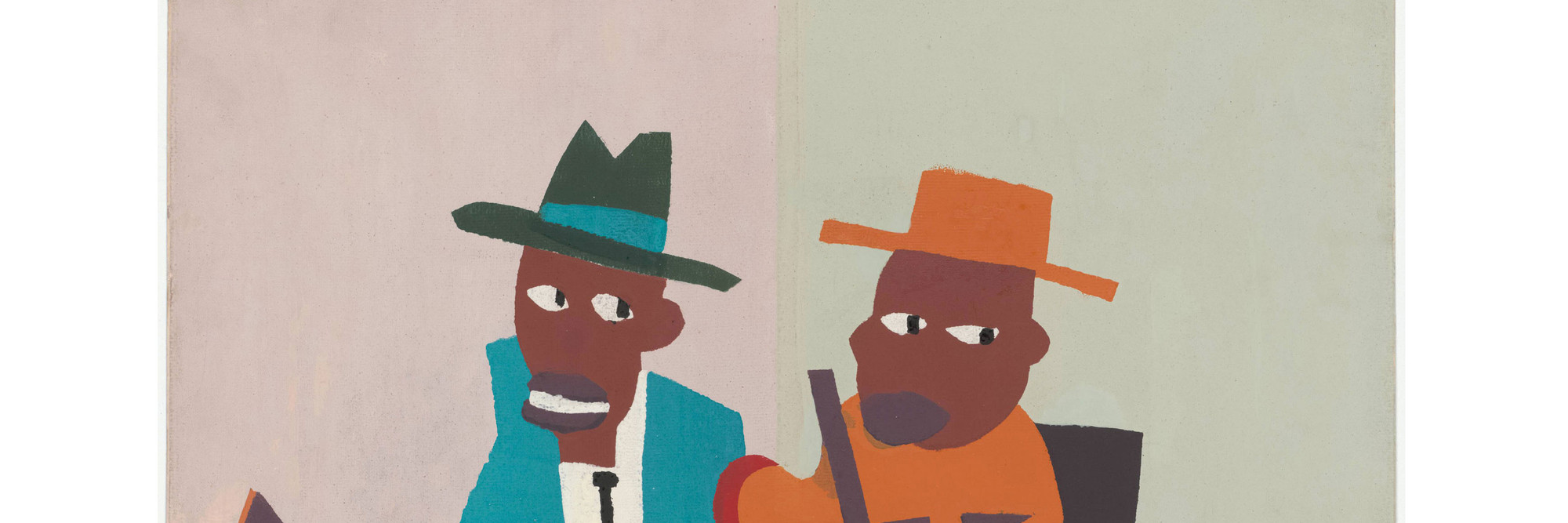
“I know of no better country to inspire me at this period of my artistic development,” the artist William H. Johnson wrote just prior to his return to the United States in 1938, after 12 years abroad in Europe. From South Carolina to Scandinavia, Johnson explored modern art techniques and experimented with restless energy. Back in New York City, he created an exuberant body of work, shaped by his classical training, his deep engagement with European avant-gardes and folk art traditions, and his lived experience as a Black American across the North and South. Johnson settled in New York’s Greenwich Village with his Danish wife, the artist Holcha Krake, and taught art in Harlem. While he belonged to many communities, he remained an outlier throughout his life.
Intimate and communal scenes come alive through the dynamism of Johnson’s compositions, bursting with bright colors and flat, bold shapes: Couples jitterbugging in music halls, farmers working the land, American soldiers in World War II, along with self-portraits, historical figures, still lives, and studies of flowers. The first large-scale presentation in New York in more than three decades of Johnson’s brief but innovative career, this exhibition provides a rare opportunity to trace the artist’s development and consider his creative process across a breadth of paintings, drawings, and prints.
Organized by Esther Adler, Curator, Department of Drawings and Prints, and Sarah Suzuki, Associate Museum Director, with Taylor Ndiaye, Curatorial Assistant, Department of Drawings and Prints.