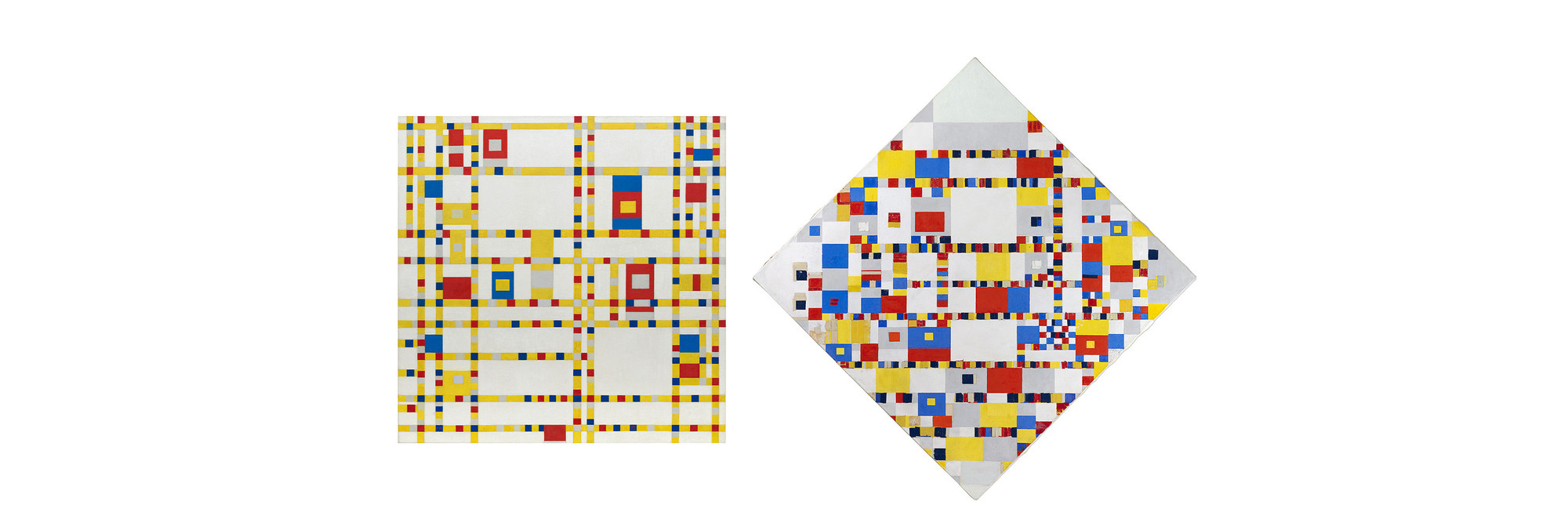
On October 3, 1940, the Dutch artist Piet Mondrian sailed into New York Harbor aboard the RMS Samaria. It had been a harrowing passage across the Atlantic as the 66-year-old painter escaped the chaos of World War II. That same night, Mondrian’s friend, the artist Harry Holtzman, played him several boogie woogie records—a percussive strain of blues piano that had recently taken New York by storm. First played by Black musicians in the American South in the 1800s, boogie woogie traveled with the Great Migration as millions of African Americans fled racial violence for opportunities in the northern cities. Mondrian soon encountered this music performed live at Café Society, New York’s first integrated nightclub, where Albert Ammons, Meade “Lux” Lewis, and Pete Johnson—three of the genre’s leading pianists—were in residence.
For Mondrian, the improvisational dynamism of this music unleashed a period of extraordinary exploration. It prompted him to revise works he had completed in Europe, to experiment with colored tape, and to liberate his compositions from the stability of the grid, giving them a new syncopated structure that made them, in the artist’s words, “more boogie woogie.” This body of work culminated in his final two paintings, which have become beloved icons: Broadway Boogie Woogie (1942–43) and Victory Boogie Woogie (1942–44), reunited for this exhibition after 30 years.
Mondrian Boogie Woogie is the first major survey of the artist’s work from his final years in New York City (1940–44). It explores two intersecting stories: Mondrian’s journey to Manhattan as a European refugee and boogie woogie’s northward migration. Featuring 30 artworks, an array of archival materials, and immersive audio experiences in the galleries, the exhibition is accompanied by a program of live musical performances.
Mondrian Boogie Woogie is organized by The Museum of Modern Art, New York, and Kunstmuseum Den Haag in collaboration with the RCE – Cultural Heritage Agency, Netherlands, and RKD – Netherlands Institute for Art History. The exhibition is organized by Leah Dickerman, Director, Research Programs, with Carlota Ortiz Monasterio, Curatorial Assistant, The Museum of Modern Art, and Margriet Schavemaker, Artistic Director, with Thijs de Raedt, Head of Collections & Exhibitions, and Caro Verbeek, Curator, Kunstmuseum Den Haag. Following its presentation at MoMA, Mondrian Boogie Woogie will be shown at the Kunstmuseum Den Haag in Mondrian’s native Netherlands from September 10, 2027, through January 30, 2028. Composer and musician Jason Moran and scholar Brent Hayes Edwards will collaborate on the musical and sound components of the exhibition and related programming at the New York venue.