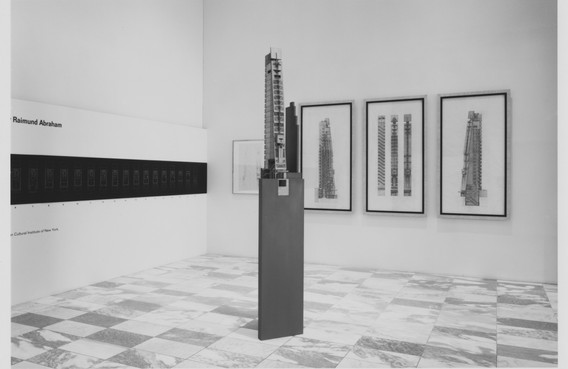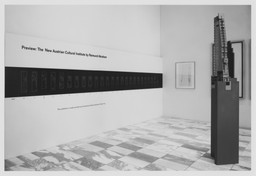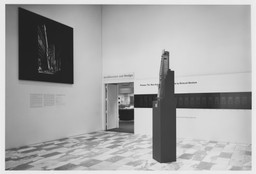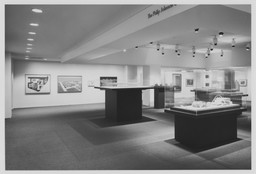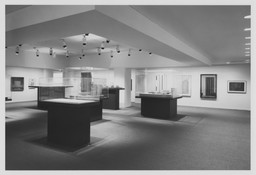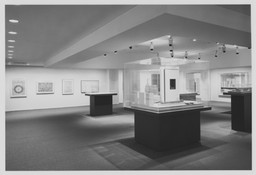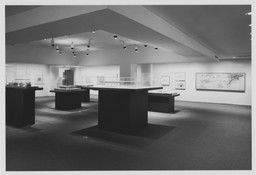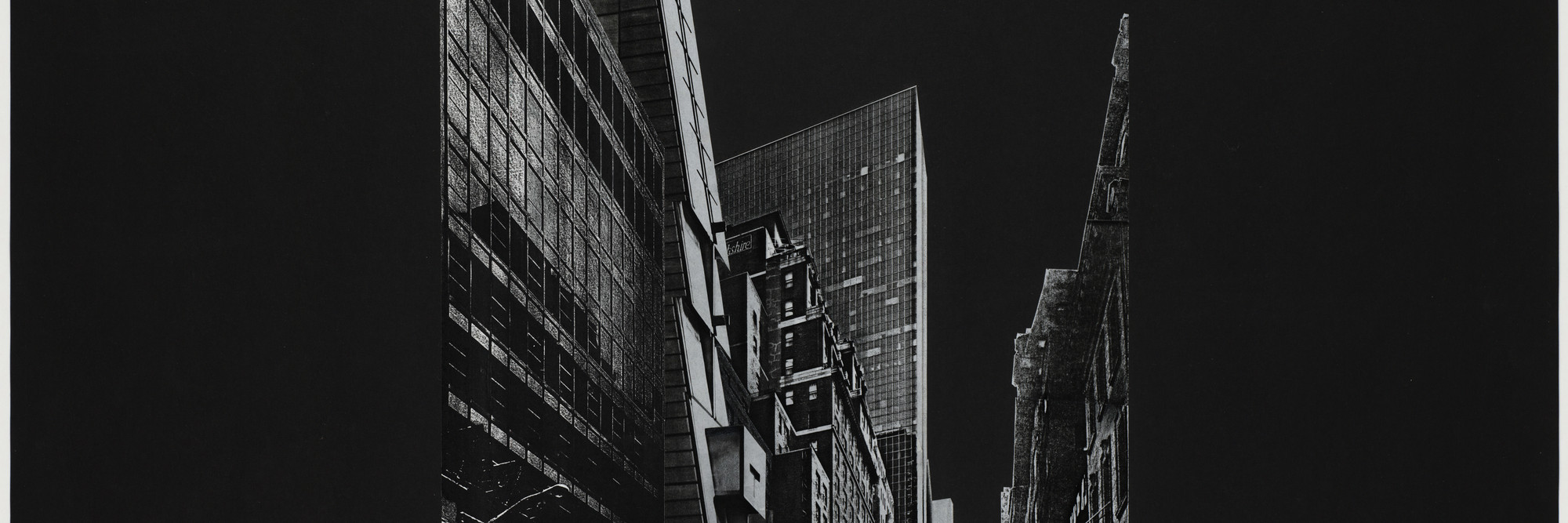
The fourth exhibition to be held in The Museum of Modern Art’s Preview series, which is devoted to small, focused investigations of important current developments in design and architecture, Preview: The New Austrian Cultural Institute by Raimund Abraham features the competition-winning design for a new Manhattan headquarters of the Austrian Cultural Institute.
The exhibition presents a model, five drawings, and twenty plans for Raimund Abraham’s twenty-story tower. The architect’s dramatic design features a metal-and-glass facade of four overlapping panels that are held in place by massive steel “vertebrae.” A solar panel atop the steep, sloping facade contributes to the building’s mask-like appearance. One of the great challenges of the project was to fit the multi-purpose structure into the narrow, twenty-one by seventy-foot lot. Abraham’s innovative design allows for three floors of exhibition space, a recital hall, a fifty-seat theater, a library, classrooms, administrative offices, and a restaurant. The building also contains seven floors of apartments for Institute staff and guests, an artist’s studio, and office suites for other Austrian representatives.
Abraham’s work was chosen from 226 entries in a 1992 competition to replace the Austrian Cultural Institute’s townhouse at 11 East 52 Street, between Madison and Fifth Avenues. The competition, held in Vienna, was open exclusively to Austrian-born architects. The jury was led by American architectural historian and critic Kenneth Frampton and included New York architects Charles Gwathmey and Richard Meier, Austrian architects Hermann Czech and Bernhard Hafner, and Austrian filmmaker Axel Corti, as well as representatives of the Austrian Foreign and Economics ministries.
Raimund Abraham was born in 1933 in the Austrian province of Tyrol and educated at the Technical University of Graz. Since 1964, he has worked in the United States, teaching first at the Rhode Island School of Design and, since 1971, at The Cooper Union in New York. He is the author of master plans for two housing settlements in Vienna, including the recently completed Siedlung Traviatagasse. His design for a residential building in Graz is currently under construction. Mr. Abraham’s other built work in New York is the interior of a courthouse renovated in the mid-1980s for Anthology Film Archives. Construction on the Austrian Cultural Institute begins next year and is expected to be completed early in 1995.
Organized by Terence Riley, chief curator, and Anne Dixon, study center supervisor, Department of Architecture and Design.