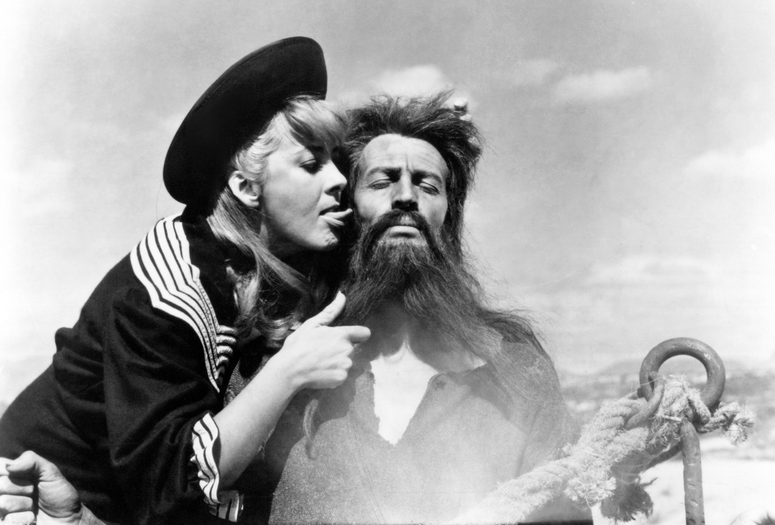
Simón del desierto (Simon of the Desert). 1965. Mexico. Directed by Luis Buñuel
. Screenplay by Buñuel, Julio Alejandro. With Claudio Brook, Silvia Pinal, Enrique Álvarez Félix, Hortensia Santoveña. 45 min. In Spanish; English subtitles. 35mm. 45 min.
The last of Buñuel’s works to be filmed in Mexico (though he continued to make the country his home base), and the third and final of his films with Silvia Pinal and her producer husband, Gustavo Alatriste. Inspired by the story of Simeon Stylites, a Syrian Christian ascetic who lived atop a pillar for 37 years, Buñuel spins an ambiguous fable about the possibilities of transcendence in a resolutely material world. Having lived six years, six weeks and six days on a small platform atop a rickety tower, Simon (Claudio Brook) has become a local celebrity who attracts patrons (who want to move him to a nicer tower) an audience of peasants hoping to see a miracle or tow, and the Devil himself, who assumes the form of Ms. Pinal for a series of imaginative temptations. Originally intended as part of a trilogy, with other episodes to be directed by Federico Fellini and Jules Dassin, it was released as a standalone 45 minute film. “Buuel's wit is piercingly sharp, his timing impeccable, and his visual style superbly unobtrusive and naturalistic -- proving again how much realism is required in surrealism” – Chicago Reader.
Screening with:
Un Chien Andalou (The Andalusian Dog). 1929. France/Spain. Directed by Luis Buñuel. Screenplay by Buñuel, Salvador Dalí. With Simone Mareuil, Pierre Batcheff. 35mm. 17 min.
It’s not a Mexican film, but it seems churlish to have a Bunuel series and not show MoMA’s vintage print of Bunuel’s first film, made in collaboration with Salvador Dalí and one of the most celebrated products of the Surrealist movement. Still shocking today, it opens with a spectacular provocation – a man, played by Buñuel, slowly and deliberately slices a woman’s eyeball in half – and evolves through a torrent of dream imagery involving everything from dead donkeys to severed hands. “A work that changed not just film but the whole world. Like discovering a new primary color.” – David Lynch.