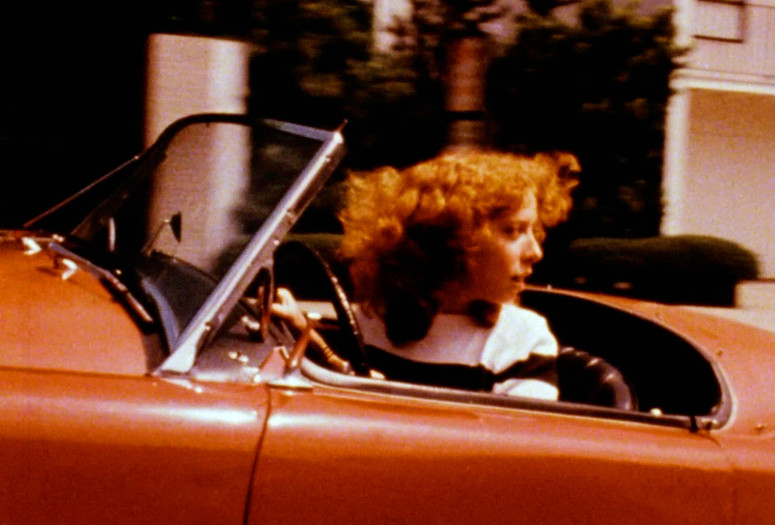
Sonbert’s filmmaking has been said to have had an influence on the avant-garde Language poets movement. In an interview, Carla Harryman wrote, “Let me digress and offer again a bit of literary biography. Throughout the '70s, I was working very actively with the sentence and the paragraph. But I also worked a bit with the line, and that work with the line actually was, in several instances, quite influenced by my viewing of experimental film. The poem "Obstacle," published in my first book Percentage, for example, was dedicated to the filmmaker Warren Sonbert, because it was written in the dark of a movie house in the Mission District of San Francisco while I was watching his film, Divided Loyalties.”
Divided Loyalties. 1978. USA. Directed by Warren Sonbert. 22 min. 16mm. Silent.
Sonbert said of the film, “So, again, the ambition might be seen as an attempt to hold finely balanced series of tensions in which one can read images a variety of ways, sometimes in contradictory stances so that there are many possibilities of interaction…there is somehow a link, a chain, by the very act of editing, of putting shots/images next to one another, that says our pleasure is somehow at the expense of another’s suffering … the filmmaker being both callous and opportunistic, sharing in the guilt, taking advantage just as much as the audience of other people’s misfortune to build his argument…the artist is cool and detached, but the reason is to shake up and disturb.”
A Woman’s Touch. 1983. USA. Directed by Warren Sonbert. 22 min. 16mm.
A Woman’s Touch is modeled after Alfred Hitchcock’s Marnie (1964) in which Tippi Hedren is subsumed by the dominating presence in her life of Sean Connery. Sonbert recreates this tension between male domination and female (in)dependence. Men are shown primarily in commanding positions of business, whereas women are shown in more domestic roles. He cuts between these modes of existence, interspersing them with abstract images of flowers, landscapes, lights at night, fireworks, and flows of water (think Stan Brakhage, Marie Menken, and other experimental filmmakers) that provide visual and mental respites. In Sonbert’s own words, “These neutral shots…are, link after-dinner sherbets, there to cleanse the palate before the next, more highly charged image.”
Surface Noise. 2000. USA. Directed by Abigail Child. 13 min. 16mm.
Cobbled from found footage that Child describes as “outtakes of outtakes”, the film is a dense collage of images with a John Zorn-like soundtrack. Sometimes the images synch with the noise; the flailings of a salmon swimming upstream is coupled with a rimshot, and home movie footage of a man laughing is paired with a female opera singer. In most of Surface Noise, however, sound and image follow their own dialectical paths, creating a density which is Child’s tribute (as a dedication at the end of the film makes clear) to the equally complex films of Warren Sonbert.
Program: 57 min.