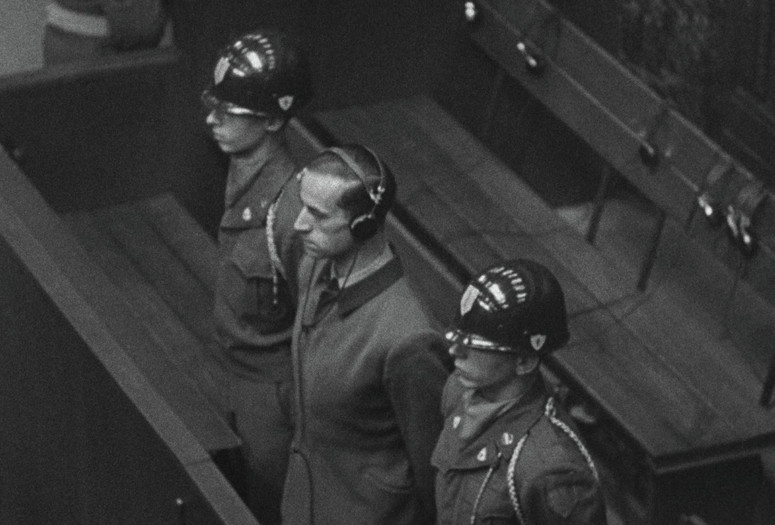
The Memory of Justice. 1976. USA/UK. Directed by Marcel Ophuls. DCP restoration courtesy of the Academy Film Archive in association with Paramount Pictures and The Film Foundation. In English, German, French; English subtitles. 278 min.
“Marcel Ophuls’s documentary at once sums up this historical moment and looks beyond it: it’s a film that bridges the gap between the inevitable climax of our Southeast Asian disaster and that postwar epilogue which is finally ours to make of what we will. Like The Sorrow and the Pity, Memory is a four-and-a-half-hour exploration of the legacy of World War II, but it has its own special focus. Ophuls is now seeking to understand how the justice dispensed at Nuremberg in 1945 holds up against the test of time—and how the legal and moral principles established then might bear on the Allied powers’ adventures in Dresden, Hiroshima, Algeria, and Vietnam. Ophuls doesn’t have glib answers to such questions—his movie is rich in contradictions, difficult nuances, anguish, and doubt and he constructs his ultimately pro-Nuremberg argument with a scrupulous and painstaking respect for all permutations of the truth” (Frank Rich, 1975).
“The postwar fate of the elite American and English Nazi appeasers and collaborators offers a glimpse of what may come. None of them were implicated in the Third Reich’s crimes against humanity. But that didn’t free them from taint and guilt. In Marcel Ophuls’s 1976 documentary about the Nuremberg trials, The Memory of Justice, a high-powered German defense lawyer whose clients included the Nazi admiral Karl Dönitz and the industrialist Alfried Krupp codified a trio of distinctions: If you were ignorant of what went on, you were a fool; if you knew but looked the other way, you were a coward; if you knew and took part, you were a criminal. Those Americans and Brits who fell into the first two categories sometimes experienced their own form of comeuppance. The classic example, of course, is Charles Lindbergh, who was at best a fool and at worst a coward” (Frank Rich, 2026).
For Laurence Braunberger, who worked with Ophuls (notably on the restoration of Lola Montès and the “Max by Marcel” bonus features), this film has particular significance today.