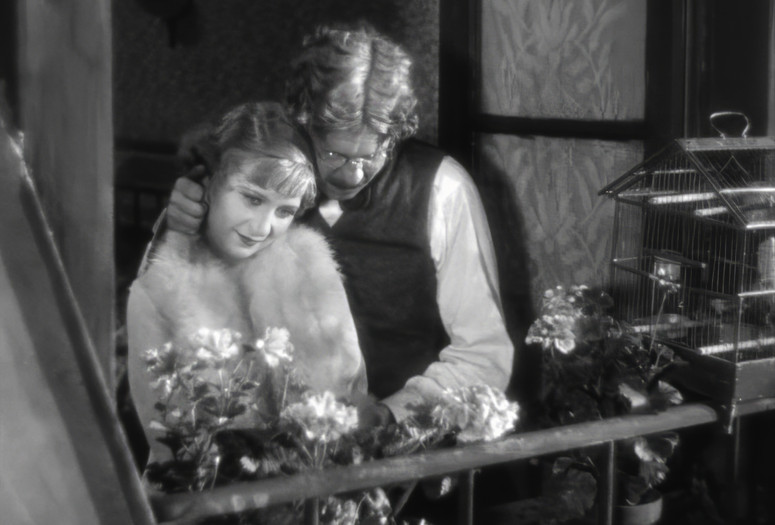
La Chienne (The Bitch). 1931. France. Directed by Jean Renoir. Screenplay by Renoir, André Girard, based on a story by Georges de La Fouchardière. With Michel Simon, Janie Marèse, Georges Flamant. 2K digital restoration. In French; English subtitles. 95 min.
“Shambolic and upright, Michel Simon’s Legrand is an unhappily married bookkeeper at a Paris lingerie firm. His belittling wife (Magdeleine Bérubet) might herself lay claim to the movie’s title [‘The Bitch’] were it not for Legrand’s succumbing to the charms of a mercenary prostitute named Lulu (Janie Marèse). Lulu is herself abjectly in love with her pimp, Dédé, a petulant, pomaded twerp played by Georges Flamant, thus completing a sadomasochistic triangle....Renoir, himself the son of a painter, has great fun satirizing the art world even as he celebrates the making of art—mainly his own....With La Chienne, Renoir invented a new sort of plein-air cinema, pioneering a fluid naturalism predicated on his ability to shoot sound on location without sacrificing the freedom to move his camera. The film, which is introduced as a puppet show that is ‘neither a comedy nor a tragedy,’ is infused with the joy of moviemaking. By crosscutting a crime of passion with a street singer’s performance, Renoir elevates tawdry melodrama to something operatic. La Chienne is at once less harsh and more devastating than Fritz Lang’s noirish Hollywood remake Scarlet Street (1945). In his juxtaposition of art and life, Renoir contrives an ending, bitter yet affirmative, that combines irony, pathos and self-reflection in one transcendent image” (J. Hoberman, The New York Times).
Essais d’acteurs. 1936. France. Directed by Jean Renoir. DCP. In French; English subtitles. 14 min.
“I’m the slave of acting,” Jean Renoir once said, “and I don’t ask the actors to work for the camera. I ask the camera to work for the actors.” André Bazin furthered this idea when he observed, “Renoir doesn’t choose his actors, as in the theater, by their conformity with a task, but as a painter does, because of what he knows that he will force us to see in them. That is why the most beautiful acting moments are almost indecently beautiful, why the trace they leave in our memory is only that of their brightness, so glaring it forces us to lower our eyes. The actor is pushed beyond himself, surprised in a kind of nakedness of being that has nothing to do with dramatic expression and that is undoubtedly the most decisive light that of all the arts, film, along with painting, can cast on man’s body.”