Toute la mémoire du monde (All the World’s Memory). 1956. France. Directed by Alain Resnais. Screenplay by Rémo Forlani, Resnais. DCP. In French; English subtitles. 20 min.
“Some years later, said Austerlitz, when I was watching a short black and white film about the Bibliothèque Nationale and saw messages racing by pneumatic post from the reading rooms to the stacks, along what might be described as the library’s nervous system, it struck me that the scholars, together with the whole apparatus of the library, formed an immensely complex and constantly evolving creature which had to be fed with myriads of words, in order to bring forth myriads of words in its own turn. I think this film, which I saw only once but which assumed ever more monstrous and fantastic dimensions in my imagination, was entitled Toute la mémoire du monde and was made by Alain Resnais” (W. G. Sebald, Austerlitz).
Las Hurdes (Land Without Bread). 1933. Spain/France. Directed by Luis Buñuel. 35 mm. In French; English subtitles. 30 min.
“And yet the climate is mild, water is abundant, and vegetation spreads out in all directions. But the climate, the water, the vegetation, the earth, all seem to want to strangle human life rather than promote it. Though the bees make honey, the honey is too bitter to eat. Though the waters are pure their very purity makes them pernicious, for they are devoid of essential mineral salts. Instead, they are the breeding ground for the dreadful anopheline mosquito. All the region’s inhabitants have malaria. I will now give the name of this region. It is called Las Hurdes and is located in eastern Spain, near the Portuguese border” (Luis Buñuel). “At the time, I was finishing up production on Las Hurdes, a film Buñuel had shot a few years earlier in a desolate region of Extremadura, Spain. He had brought Pierre Unik and Eli Lotar over from Paris; I had lent them a camera and given them film. Originally, the film was silent, and Buñuel would provide commentary during public screenings. I bought it and added sound” (Pierre Braunberger, producer).
Guernica. 1950. France. Directed by Alain Resnais, Robert Hessens. Screenplay by Paul Éluard. 2K digital restoration. In French; English subtitles. 14 min.
Pablo Picasso’s tortured response to the horror, chaos, and barbarism of the Nazi bombing raid on the Basque village of Guernica on April 26, 1937, took the form of a radical and timeless large-scale painting, Guernica, that was safeguarded by MoMA during Francisco Franco’s military dictatorship in Spain and now is displayed at the Museo Reina Sofía in Madrid. Alain Resnais and Robert Hessens’s short film of the same name evokes Picasso’s Cubist expressionism through a montage of still images (anticipating Chris Marker’s La Jetée by 12 years), an antiwar poem by Paul Éluard narrated by Maria Casares, and a score by Guy Bernard.
La Frontière. 1961. France. Written and directed by Jean Cayrol, Claude Durand. DCP. In French; English subtitles. 17 min.
“Dedicated to ‘the exiled, proscribed, expelled, banned,’ this montage of documentary images codirected and written by Jean Cayrol—a former deportee who wrote the commentary for Alain Resnais’s *Night and Fog*—makes the Spanish Civil War a synecdoche for all forms of brutal exclusion” (Jean-Michel Frodon).
Van Gogh. 1948. France. Directed by Alain Resnais. DCP. In French; English subtitles. 19 min.
Of Alain Resnais’s Academy Award–winning short film, producer Pierre Braunberger recalled that “although [filmmaker Claude] Autant-Lara’s anti-Semitism had subsided (fifteen days before the end of the war), I did everything in my power after the Liberation, along with my group of friends in the film industry, to ensure he was boycotted. I myself had Resnais direct the short film about Van Gogh in 1948 to prevent Lara—who was in negotiations with the United States—from making a feature-length film on that subject.”
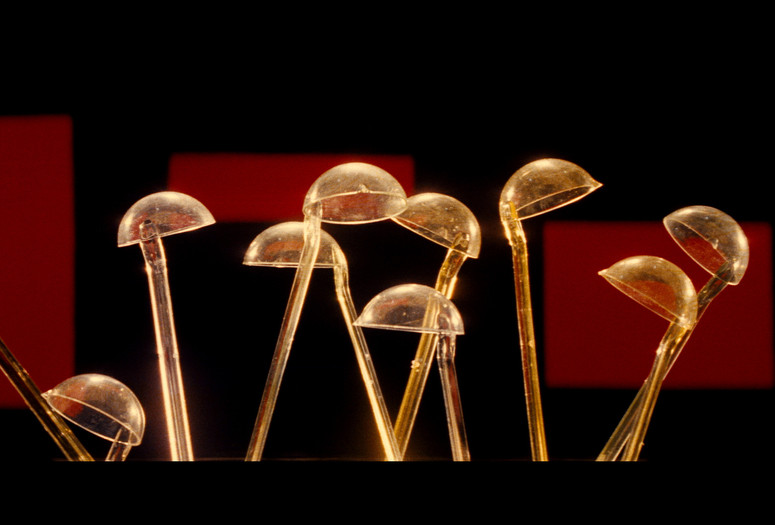
Chant du styrène (The Song of Styrene). 1958. France. Directed by Alain Resnais. Screenplay by Raymond Queneau. 2K digital restoration. In French; English subtitles. 13 min.
Commissioned by Péchiney, a French chemical and aluminium company, to trace the metamorphosis of polystyrene into everyday plastic products, Alain Resnais made this dazzling exercise in Eastmancolor Surrealism by turning synthetic forms into flora and fauna and the Alexandrine verse of Raymond Queneau into a playful meditation on the philosophy of matter.
Program approx. 113 min.