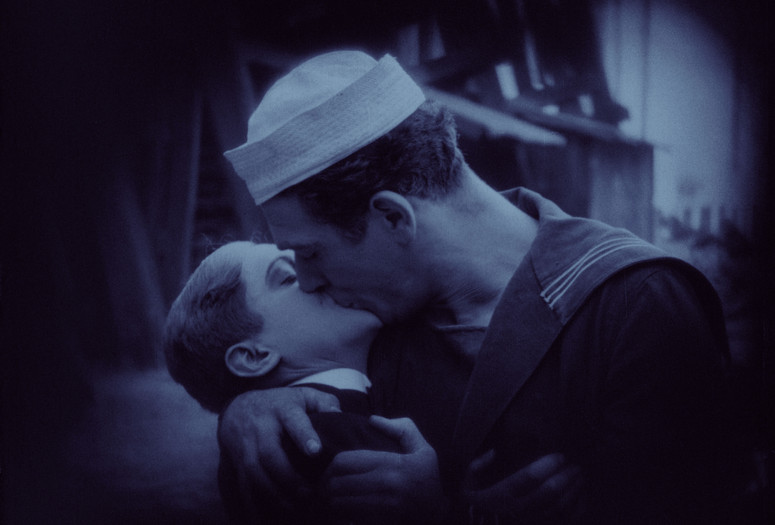
Rien que les heures (Nothing but Time). 1926. France. Written and directed by Alberto Cavalcanti. With Blanche Bernis, Nina Chousvalowa, Philippe Hériat. 4K digital restoration. Silent; with musical track. 45 min.
With its lush and brooding atmosphere, the Brazilian-born Alberto Cavalcanti’s Rien que les heures heralded a new film genre, the city symphony, and did for Paris what Paul Strand and Charles Sheeler’s Manahatta did in 1921 for New York. Both films burnish the romance of the new metropolis in our collective subconscious, tracing in a melodic arc from dawn to dusk to dawn the intricate choreographies of the man in the crowd and machines in concert with nature, the rhythms of rain and regulated time, the abstract geometries of pattern and movement and shadow. Throughout, Cavalcanti experiments in dazzling ways with montage, double exposure, and slow motion while inserting sly Marxist critiques of material want and greed.
La p’tite Lili. 1927. France. Written and directed by Alberto Cavalcanti. With Catherine Hessling, Guy Ferrant, Dido Freire. 2K digital restoration. Silent; with musical track. 15 min.
Filmed over three days when bad weather halted his film adaptation of Guy de Maupassant’s 1884 novella Yvette, Alberto Cavalcanti’s La p’tite Lili is a wonderfully improvised burlesque starring Jean Renoir as a pimp and his then-wife, Catherine Hessling, as a prostitute. “Cavalcanti was close to the Surrealists and shared their sense of playfulness and humor,” producer Pierre Braunberger would recall. “La p’tite Lili wasn’t a Néo Films production, but I provided all the funding for it. It was a short film based on a collaborative idea by Pierre Lestringuez, Jean Renoir, and Alberto Cavalcanti. Renoir played a role in it and even helped direct part of it. Renoir and Cavalcanti, though very different, were bound by a genuine friendship. The musicians Darius Milhaud and Maurice Jaubert would later collaborate on the sound version.”
On purge bébé (Baby’s Laxative). 1931. France. Directed by Jean Renoir. Screenplay by Renoir, Pierre Prévert. With Marguerite Pierry, Jacques Louvigny, Michel Simon. 2K digital restoration. In French; English subtitles. 46 min.
Based on a bourgeois farce by Georges Feydeau, Jean Renoir’s first talkie was not only a breakthrough for the great French actors Michel Simon and Fernandel but also a remarkable experiment in directing with multiple simultaneous cameras and new sound technologies. Pierre Braunberger, who produced many of Renoir’s formative films, observed, “Talkies in France hadn’t even been around for two years when I produced On purge bébé and La Chienne. What could be more beautiful than the murder of Lulu (Janie Marèze) by Legrand (Michel Simon) while you hear the street singer below? Or, in On purge bébé, which was made earlier—and thus truly at the dawn of the sound era—when Renoir playfully incorporates the sounds of a flushing toilet or smashes chamber pots! Renoir, like all great filmmakers, assimilated sound cinema just as he had assimilated silent cinema—with his genius and his style.” Renoir himself would recall, “To prove that I could shoot a talking film without bankrupting the producers, I made a little film called On purge bébé, taken from Feydeau. It was a tremendous financial success. I wrote it in six days, shot it in six days, and edited it in six days. Six days later it was showing at the Gaumont Palace and six days after that it was making a profit. After that I was a great man, and they allowed me to do La Chienne.”
Program approx. 106 min.