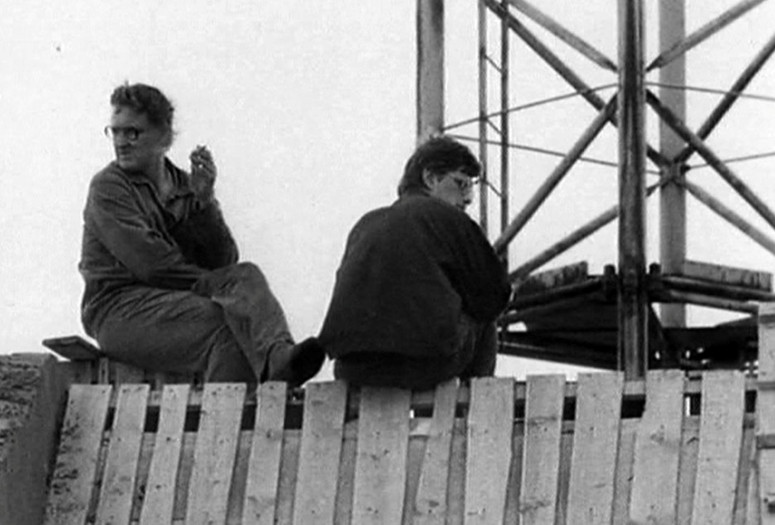
Today We Are Going to Build a House (СЕГОДНЯ МЫ ПОСТРОИМ ДОМ). 1996. Russia. Written and directed by Sergei Loznitsa, Marat Magambetov. DCP courtesy Atoms & Void. No dialogue. 28 min.
Even the title of Sergei Loznitsa’s sophisticated debut is a wry send-up of all those Socialist Realist agitprop films extolling the superhuman Soviet worker. (After all, who can build a house in a single day?) While students at the prestigious Russian film school VGIK under the tutelage of Oscar-nominated Georgian filmmaker Nana Dzhordzhadze, Loznitsa and his friend, Kazak editor Marat Magambetov, made this formally subversive study of a construction site, focusing not on heroic acts of labor but on cigarette breaks and stray dogs, nearly slapstick antics involving wood planks and ladders, and the detritus of rusted metal, broken concrete, and discarded newspaper. Contemporary critics saw in the film a critique or lamentation of post-Soviet society, a vision of emotional paralysis brought on by political and economic collapse. But Loznitsa and Magambetov were up to something far more poetic and abstract, their complex montage built from diurnal weather patterns of storm and sun, repeated camera movements, unusual sounds (a howling wolf, a wailing baby), and the shifting tempos of once-banned Estonian folk ballads and waltzes. In the end, the dilapidated building has been magically transformed, restored to its former gleam, and the pace of human activity, with its leisurely pauses and harmonious synchronicities, is seen in a more forgiving, even salutary, light.
Life, Autumn (ЖИЗНЬ, ОСЕНЬ). 1998. Germany/Russia. Written and directed by Sergei Loznitsa, Marat Magambetov. No dialogue. DCP courtesy Atoms & Void. 34 min.
The peasants and babushkas of the western Russian region of Smolensk bear the toils of farm life and the hardships of getting old with warmth, humor, and acceptance, recounting stories of love and loss, singing folk songs of arranged marriages to incorrigible drunkards, and slaughtering pigs with an inveterate stroke of the blade. Rooted in a tradition of rural portraiture that hearkens back to Jean-François Millet, August Sander, Alexander Dovzhenko, and Dorothea Lange, Sergei Loznitsa’s Life, Autumn is a hymn to a dying folklore in a region that has seen its share of war, destruction, and cultural erasure across the centuries: claimed at various times by Lithuania, Poland, and Russia; invaded by Napoleon in 1812 and the Nazis in 1941; the site of the Katyn massacre in 1940 and an air disaster in 2010 of still-contested cause; and today a strategic target of Ukrainian drone attacks.
The Halt (ПОЛУСТАНОК). 2000. Russia. Written and directed by Sergei Loznitsa. DCP courtesy Atoms & Void. No dialogue. 25 min.
A night train roars into a station deep in the northwest Russian woods, the sweat of steam rising from its iron chassis. Malaya Vishera sits roughly midway between Moscow and Saint Petersburg, and while the town was once a center of glassmaking and timber, Sergei Loznitsa’s third film has a different focus: the station’s waiting room, a purgatory of lumpen, snoring bodies awkwardly sprawled on hard benches. Bathed in a gauzy, timeless light, the men, women, and occasional child in this way station are oblivious to the buzzing of flies, the patter of rain and howl of wind, and the need for any sort of decisive action.
Program approx. 87 min.