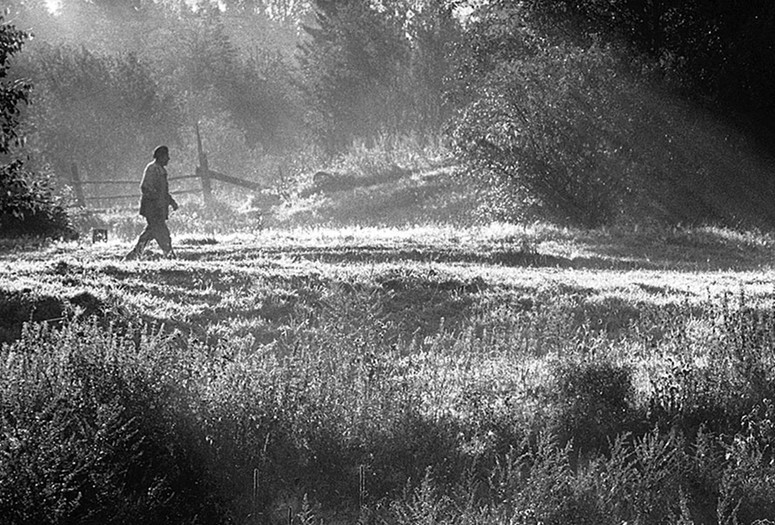
Portrait (ПОРТРЕТ). 2002. Russia. Written and directed by Sergei Loznitsa. DCP courtesy Atoms & Void. No dialogue. 28 min.
Ominous rain clouds, a recurring trope of Sergei Loznitsa’s early films, once again gather as the curtains open on Portrait. Like some contemporary August Sander, Loznitsa documents the Russian peasantry in stark frontal poses. The commonality of rural life anywhere and everywhere—the familiar weather-bitten faces, the stock expressions of humility and resilience, the well-handled tools of the trade, whether axe or logging sled or wheelbarrow—is belied by the evocative specificity of their particular circumstances: the two men who could pass for twins, the lumberjack with his crosscut saw poised in mid-action, the hobo (hobo?) who with his rucksack seems to be just heading off to the train behind him. These characters, or their types, seem frozen in time and place, but the landscape is perpetually changing, from the icy winter with its unforgiving winds to the spring thaw of birdsong, dandelion seeds, and freshly tilled earth in shimmering heat.
Settlement (ПОСЕЛЕНИЕ). 2001. Russia. Written and directed by Sergei Loznitsa. DCP courtesy Atoms & Void. 80 min.
Winner of a jury prize at the Karlovy Vary Film Festival, Sergei Loznitsa’s debut feature observes the daily lives of people with mental disabilities in Oksochi, a communal psychiatric hospital in the Russian countryside. There is an air of peaceful contentment as the men and women tend the livestock, air the carpets, write letters, and read books, but darker images also intrude: images of collective fieldwork, silent canteen meals, and uniformly shaved heads that seem to echo a Soviet past of castigation, confinement, and rote labor. Loznitsa’s language is vernacular and unvarnished, his camera positioned frontally or at a remove, his soundscape an almost hyperreal concatenation of buzz saw, crackling fire, and muttered chatter. The film’s denouement, a progression of portraits set to Vladimir Vavilov’s “Ave Maria,” ennobles and enriches this marginalized community. Tragically, in 2013, 12 years after the film’s release, a fire tore through the 19th-century timber hospital, killing 36 patients and a nurse who tried to rescue them.