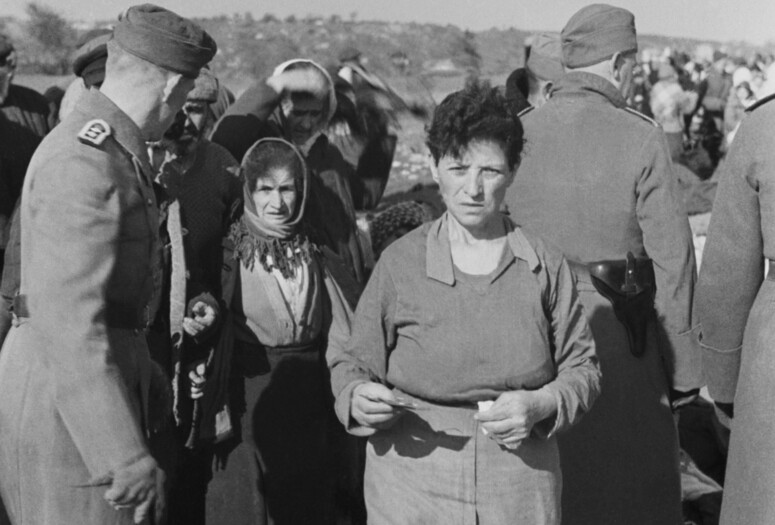
Babi Yar. Context (БАБИЙ ЯР. КОНТЕКСТ). 2021. Netherlands/Ukraine. Written and directed by Sergei Loznitsa. DCP courtesy Atoms & Void. In Ukrainian, Russian; English subtitles. 121 min.
In late September 1941, Nazi forces abetted by Ukrainian collaborators carried out one of the largest mass executions of the Holocaust when they rounded up and massacred an estimated 33,771 Jews in Babyn Yar, a giant ravine on the outskirts of Kyiv. Sergei Loznitsa marshals hours of archival footage—it’s shocking that this material was filmed, much less survived—to provide historical context and irrefutable evidence of this long-suppressed atrocity. There were few survivors to bear witness to these horrors. “Over the next two years of German occupation,” M. Gessen reports, “tens of thousands of others—Roma, people with mental illnesses, witnesses to murder, Soviet prisoners of war, and still more—were killed in the ravine,” and Soviet authorities did what they could to erase much of this history, not wanting Jewish (or Roma or Ukrainian) suffering to overshadow the blood shed by tens of millions of ethnic Russian martyrs during the war. (Stalin’s historians also glossed over the Soviet Union’s two-year alliance with Nazi Germany as well as its invasion of Finland, the Baltic States, Poland and Romania.) The Holocaust was virtually unknown to most Soviet citizens when Anatoly Kuznetsov’s autobiographical Babi Yar, his self-described “document in the form of a novel,” was first published in a Soviet magazine in 1966. Soviet party censors eliminated the most damning passages, a full quarter of the manuscript, and it wasn’t until after Kuznetsov defected to England in 1969 that the book, so precise and free of sentiment in describing unspeakable horrors—a tone that Loznitsa adopts—would be published in full. Even so, nearly 75 years would pass before an independent Ukraine pledged in 2015 to properly memorialize Babyn Yar, plans that were derailed when in 2022, a year after Loznitsa made this film, Russia launched its first full-scale invasion and an errant missile, intended for a television tower in Kyiv, exploded on the site. As the poet Yevgeny Yevtushenko famously wrote in 1961, “No monument stands over Babi Yar.”