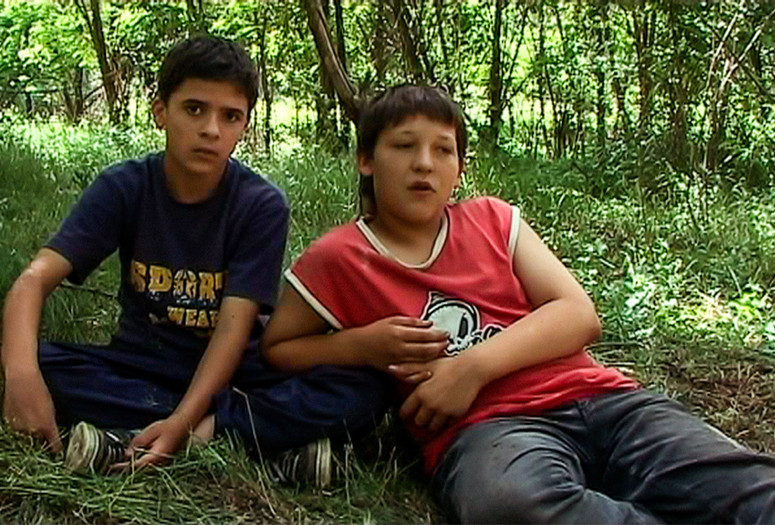
Tous les enfants sauf un (All the Children but One). 2008. Germany. Directed by Andreas Bolm, Noëlle Pujol. DCP. In Hungarian; English subtitles. 39 min.
Histoire racontée par Jean Dougnac (Story told by Jean Dougnac). 2010. France. Directed by Noëlle Pujol. DCP. 40 min.
While Claire Atherton’s working process varies from film to film, it always begins by watching rushes with the director, without a set concept, to discover the project in images. In the case of All the Children but One, which follows a group of children in a Hungarian village grappling with the death of one of their own shortly before his 10th birthday, this step was formative in the direction of the work. Codirectors Noëlle Pujol and Andreas Bolm hailed from different backgrounds—she from visual art, he from narrative cinema—and these initial conversations with Atherton brought initially tangential footage from location scouting and Super 8 cameras into the edit. Ultimately, the range of material allows a potent rhythm to unfold. Alternating between pure imagery and storytelling and between different temporalities tenderly evokes the loss of innocence and the disorientation of grief as seen through childhood eyes.
A few years later, Pujol and Atherton collaborated on another project, revisiting footage shot for the 2002 film VAD (Visite à domicile), which chronicled the filmmaker’s first meeting, as an adult, with her biological mother (a project partly inspired by seeing Maurice Pialat’s L’enfance nue at a 1999 Cinémathèque française retrospective). In making that film, Pujol met one Jean Dougnac: “In the confined space of a bedroom, an old man lying on his bed has been waiting for me for thirty years(…) I set my DV camera at the foot of the bed. The frame turns the room into a theatre stage. It is not an interview, but a polyphonic monologue in one long static shot. Juggling with two tongues, French and Occitan, Jean Dougnac tells me the singular story of my parents, from whom I was separated at birth.” Through a few simple but decisive edits, finding pauses that create space for a viewer, this footage became a stand-alone work. “Working with Noëlle helped me understand what my work really was,” Atherton has noted.