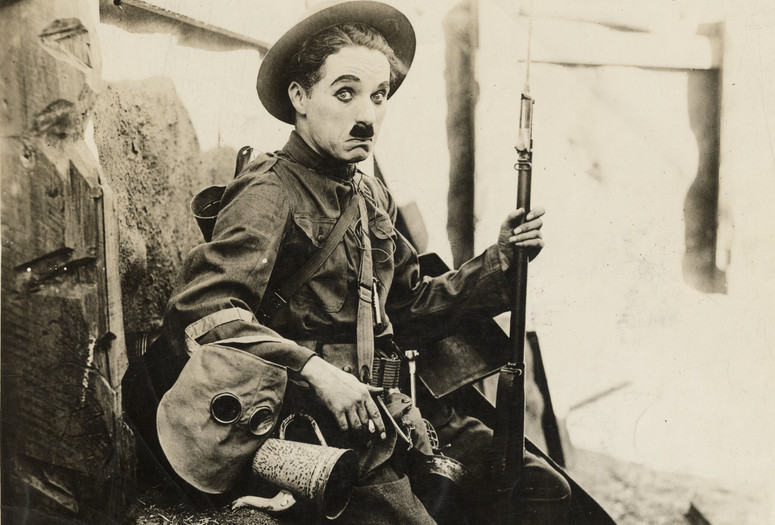
Shoulder Arms. 1918. USA. Written and directed by Charles Chaplin. With Charles Chaplin, Edna Purviance, Sydney Chaplin, Henry Bergman, Albert Austin. Preserved and restored by The Museum of Modern Art. World premiere of original 1918 restored cut. DCP. 46 min.
Preceded by
A Dog’s Life. 1918. USA. Written and directed by Charles Chaplin. With Charles Chaplin, Edna Purviance, Sydney Chaplin, Henry Bergman, Albert Austin. 33 min. Preserved and restored by The Museum of Modern Art under the aegis of Association Chaplin and Roy Export S.A.S, with generous support provided by Barbara Wertz. World premiere of original 1918 restored cut. DCP.
The Bond. 1918. USA. Written and directed by Charles Chaplin. With Chaplin, Edna Purviance, Albert Austin. Silent. 11 min. DCP.
In June 1917, Charles Chaplin signed a contract with First National Exhibitors’ Circuit that guaranteed him something no comedian had previously held: ownership of his negatives and copyrights. But when Chaplin went to reissue his initial First National films for a 1959 compilation titled The Chaplin Revue, he found that the original negatives had been damaged beyond repair, and he asked his longtime cameraman Rollie Totheroh to reconstruct them using outtakes and alternate footage. Effectively, this meant that the actual films that audiences saw on the first release dropped out of sight, replaced by new versions that did not reflect Chaplin’s first choice of angles and takes.
Working closely with the Chaplin estate and drawing on footage generously provided by archives around the world, MoMA has reconstructed the original 1918 release versions of A Dog’s Life and Shoulder Arms (the latter was first shown as a work in progress in 2025 and has now been completed).
A Dog’s Life is a three-reel comedy that parallels the Tramp’s struggle for survival with that of a stray mutt named Scraps, and the structural conceit lets Chaplin push past the pure knockabout of his Keystone and Mutual shorts toward something more deliberate. The comedy is still rooted in physical precision—Chaplin’s timing in a sequence where he steals food from a lunch wagon is meticulous—but the film’s sympathies are organized around class conflict rather than anarchic chaos. The Tramp and the dog are in the same position, scrounging at the edges of a society that has no place for either of them.
Edna Purviance plays a dance-hall singer whose own precariousness mirrors theirs, and the scenes between her and Chaplin have a gentleness that anticipates the emotional register of The Kid three years later.
Released in October 1918, weeks before the Armistice, Shoulder Arms was the first comedy to treat the war as material for sustained burlesque, and Chaplin’s colleagues warned him the timing was suicidal. They were wrong. It became his biggest commercial success to date and was especially popular with returning soldiers. Chaplin plays a hapless doughboy who moves from boot camp through the trenches to a mission behind enemy lines, where he disguises himself as a tree, meets a French girl (Edna Purviance), and somehow captures the Kaiser.
Chaplin finds gags in flooded bunks, in mail calls, in the improvised routines of men stuck in a squalid holding pattern. The physical conditions are played for laughs but never quite emptied of their grimness. Sydney Chaplin makes several appearances, including a lively turn as a German officer, and the whole production shows the benefit of the expanded format Chaplin had adopted at First National, which gave his comedy room to develop situations instead of racing through them.
Also on the program is MoMA’s new digital restoration of The Bond, a seldom-seen propaganda short produced by Chaplin for the 1918 Liberty Loan drive. On a stylized set, Chaplin demonstrates the various sorts of bonds—friendship, marriage, Liberty—culminating in an encounter with the Kaiser. (Spoiler alert: a giant mallet is involved.) This restoration is based on a 35mm reissue print held by MoMA, with the titles revised to reflect the 1918 version distributed by First National.
Funding provided by the Lillian Gish Fund for Preservation.