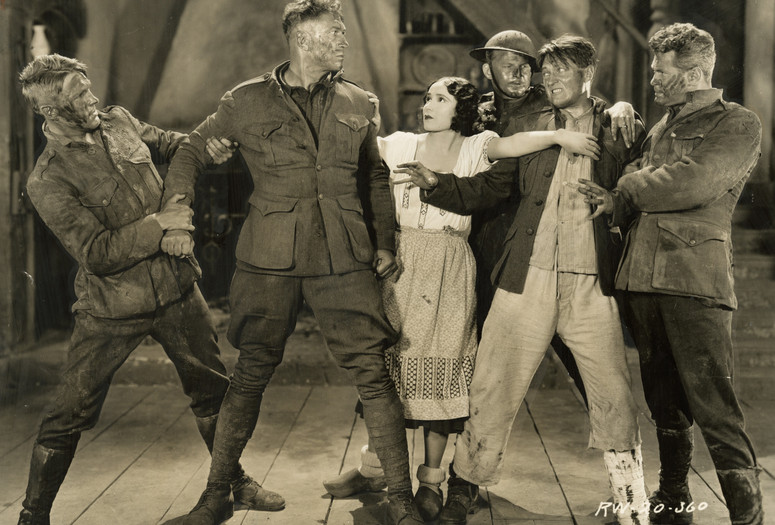
What Price Glory. 1926. USA. Directed by Raoul Walsh. Screenplay by James T. O’Donohoe, based on the play by Maxwell Anderson and Laurence Stallings. With Victor McLaglen, Edmund Lowe, Dolores Del Río, William V. Mong, Phyllis Haver. Preserved and restored by The Museum of Modern Art and the Film Foundation. US restoration premiere. 116 min.
Released the year after King Vidor’s The Big Parade (1925), Raoul Walsh’s adaptation of Maxwell Anderson and Laurence Stallings’s hit play offers a pointedly different account of the war. Where Vidor courts elegy, Walsh stays ground level and unsentimental: the trenches are chaotic, the humor is coarse, and the only thing the blustering Captain Flagg and his sergeant, the slippery Quirt. are fighting over, most of the time, is a woman. Film historian Lea Jacobs has noted how the film systematically refuses the conventional satisfactions of the war picture—no sacrifice redeemed, no lesson drawn. The competition between Flagg (Victor McLaglen) and Quirt (Edmund Lowe) runs from the café where the innkeeper’s daughter, Charmaine (Dolores Del Río), plays them against each other, through the fighting, and back again, with the war itself treated less as moral crucible than as recurring inconvenience. The battle sequences have a density and confusion that were new in 1926; John Ford directed the second unit work and brought his own eye for soldierly chaos to the material.
Walsh fills the frame with constant peripheral action—soldiers arguing, moving, loitering, flirting in the middle distance and background, creating the sense of a larger world pressing in around the main story. McLaglen and Lowe clicked so well that Fox kept them paired through several sequels; Del Río holds her ground against both of them with a composure that gives Charmaine more agency than the plot might seem to require.