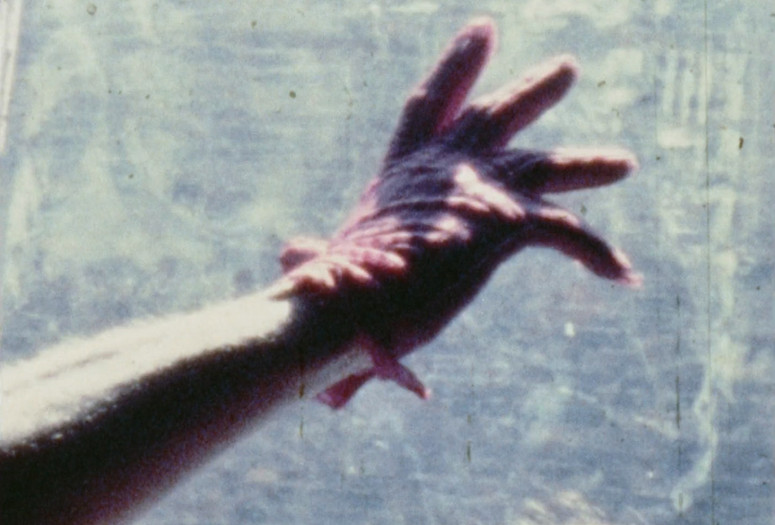
Teo Hernández was at the center of an intimate group of filmmaker friends who shaped and reshaped one another’s practices, sharing performers, spaces, gestures, desires, and visual ideas. At the core of what Dominique Noguez called “School of the Body,” the works of Michel Nedjar and Jakobois are primarily concerned with the direct, impulsive responses of the filmmaker’s body to the bodies and spaces they film. When considered alongside Teo Hernández’s work—Nedjar’s film Gestuel was his stimulus to abandon the languorous rhythms of his early films—they reveal an intimate creative community in motion, wherein cinema unfolds as a living process, porous and inseparable from the bonds that sustained it.
Teo. 1978. Directed by Michel Nedjar. Super 8 mm transferred to 16 mm. Courtesy Mnam/Cci Centre Pompidou. Silent. 6 min.
“It’s eros and thanatos. And then, the skull was a Mexican reference” (Michel Nedjar).
Le Gant de l’autre. 1977. France. Directed by Michel Nedjar. Super 8 mm transferred to 16 mm. Courtesy Mnam/Cci Centre Pompidou. Silent. 15 min.
“At that time I was still working at the flea market; there I found a pair of blue nylon gloves and another red pair, which would become the accessories of my film. I asked Gaël and Teo to wear the gloves…and whether they would agree to pose naked, making love in the apartment where we lived as a community” (Michel Nedjar).
Gestuel. 1978. France. Directed by Michel Nedjar. Super 8 mm transferred to 16 mm. Courtesy Mnam/Cci Centre Pompidou. 19 min.
“If it was violence, I didn’t realize it. It was more an effacement and a tearing. And then there was the idea of a participation with the other, between the one in front of the lens and me behind the camera” (Michel Nedjar).
Grappe d’yeux. 1982–83. France. Directed by MétroBarbèsRochechou Art. Super 8 mm transferred to 16 mm. Courtesy Mnam/Cci Centre Pompidou. Silent. 14 min.
“In this film there are four pairs of eyes, eight eyes—eight is the symbol of infinity. […] These four gazes are pressed to make an eye-juice. Four singular gazes entering into osmosis. A cluster of eyes [Grappe d’yeux]: eyes in a cluster that we press to make juice” (Michel Nedjar).
Pluie de roses. 1984. France. Directed by Jakobois. Super 8 mm transferred to 16 mm. Courtesy Light Cone. 3 min.
“Seen from above, from a bridge crossing the Canal Saint-Martin, with the barges Rose and Pluie de roses passing each other; chance occurrences multiply, and the camera demultiplies them through frame-by-frame movement, in a mise en abyme of the cataract” (Jakobois).
Passage du désir. 1988. France. Directed by Jakobois. Super 8 mm transferred to 16 mm. Courtesy Light Cone. 11 min.
“My films are suites of variations on anecdotes of the everyday (at the level of lived experience, somewhere) that have captured my gaze. Cinema that is too personal, navel-gazing, yes, navel-gazing, since through my navel I perceive worlds, through the keyhole offered to us by the camera-eye” (Jakobois).
Total running time: 68 min.
This screening may include flashing and flickering images that can impact people who are sensitive to blinking lights.