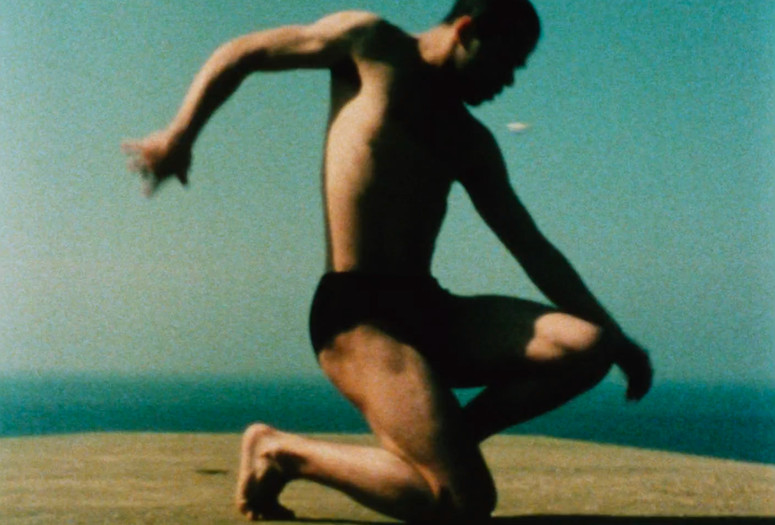
Nuestra Señora de París is an optical and gestural exploration of speed and color, tempered by light. Before the stained-glass windows of Notre-Dame, Teo Hernández’s camera inhales space, which becomes pliable and elastic. The swaying of the camera with a turn of the wrist seems to arise from an activation of memory in Le Voyage au Mexique, his first return to his origins in 15 years. The filmmaker confronts his past in an affective, impressionistic chronicle of streets, stones, and vanishing sounds, captured three years before his own death. Finally, in Pas de ciel, his knots and contortions are set in counterpoint and reflection with those of the dancer Bernardo Montet, portrayed before the Norman coast, in whose force Hernández found a new tensioned limit of his body.
Tables d’hiver. 1978–79. Directed by Teo Hernández. Super 8 mm. Courtesy Light Cone. 29 min.
Tables d’hiver depicts the communal domestic life of the filmmaker and his closest collaborators as intimate ceremony, mythologizing meals, friendship, and the passing of time. “At the end of Tables d’hiver, the camera revolves around me. A turn around me all the way to Gaël who dissolves into black against the window. This film is a screw driven deep into the night, into the soul (it is a complete turn around me); it is a turning of my life” (Teo Hernández).
Nuestra Señora de París. 1981–82. Directed by Teo Hernández. Super 8 mm transferred to 16 mm. Courtesy Mnam/Cci Centre Pompidou. 22 min.
“Nuestra Señora de París is Teo’s acme! With Jakobois’ soundtrack, it’s grandiose—how he manages to deconstruct and reconstruct Notre-Dame! He goes beyond cinema grounded in dreams, mythology, or grand narratives. He becomes a visual artist!” (Michel Nedjar).
Le Voyage au Mexique. 1990. France. Directed by Teo Hernández. Super 8 mm transferred to 16 mm. Courtesy Mnam/Cci Centre Pompidou. 29 min.
“I realized that the image is born from a nervous reflex, from a reaction of the bones. I thought of Pancho Villa and his advice on shooting: it’s about knowing with which finger to pull the trigger, and placed in which way. It’s a secret path that runs from the arm to the shot, where the arrest of the image occurs. The instantaneous halt, death” (Teo Hernández).
Pas de ciel. 1987. France. Directed by Teo Hernández. Super 8 mm transferred to 16 mm. Courtesy Mnam/Cci Centre Pompidou. Silent. 29 min.
“Faith saves dancers. It is the gift of their blood. In the screech of tires, of bones, we hear spring. When we watch these dancers dance and surrender themselves, we say: they’re going to die! And in fact, their work, their dance, consists in that: emptying the space of their death, creating a void so their death may be seen more clearly” (Teo Hernández).
Total running time: 109 min.