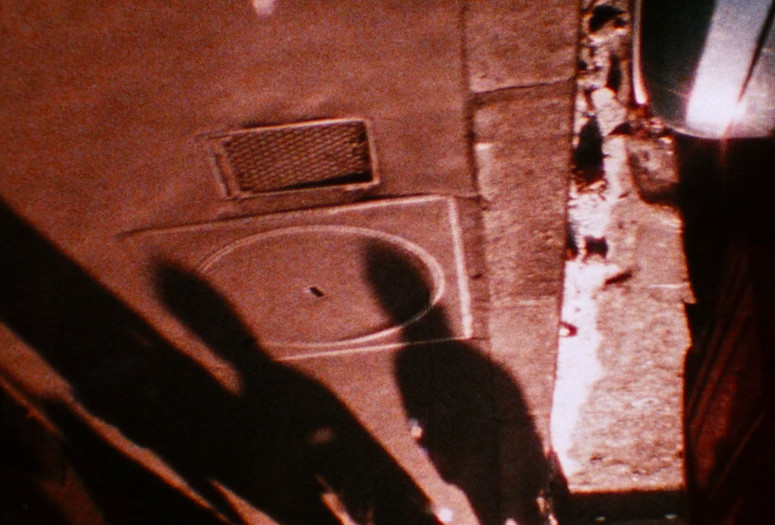
Capitale-paysage. 1982-83. France. Directed by Michel Nedjar. Super 8 mm transferred to 16 mm. Courtesy Mnam/Cci Centre Pompidou. 71 min.
Michel Nedjar aspired to glimpse Paris from within the city’s materiality, and engaged in more than a year of flaneur-filming on the streets. Inspired in part by Dziga Vertov’s Man with a Movie Camera, Capitale-paysage begins at ground level, tracing gutter edges and passing shadows before gradually lifting toward open sky. In the middle ground, the whole city vibrates incessantly: birds swell into gargantuan silhouettes and architecture dissolves into pulses of light and color. Nedjar condenses urban life into a string of sensations: fragments of conversation, musique concrète, shifting textures, and kaleidoscopic rhythms. Paris emerges not as a monument but as a flux of energy, heterogeneous, tactile, and alive, in an ecstatic homage shaped from movement, noise, gesture, and the nature of the Super 8 mm image itself. “It is my body in the city, in matter. When I film, I have the feeling of making a sculpture. At first, I more or less know what I’m doing, but then at some moment I lose myself completely. To lose, which also means to receive, to receive, to receive…. To such an extent that there are moments, in Capitale-paysage, when everything interested me, and I realized that the tiniest speck of dust or a piece of dirty paper or the smallest glimmer of light was the city” (Michel Nedjar).