Rumeurs Saint-Maur. 1986. France. Directed by Jakobois. Super 8 mm transferred to 16 mm. Courtesy Light Cone. 17 min.
With Rumeurs Saint-Maur, Jakobois engages in reimagining public space in a jaunty portrait of Rue Saint-Maur in Paris. “‘Noises of images’ arrive from the windows facing rue Saint-Maur (the old road of pilgrims returning to Saint-Denis), making me want to look more closely. At the same time, ‘images’ springing from the T.S.F. radio station—Louis Moreau Gottschalk starts playing the keyboard at the pedestrian crossing down below, just beneath my windows, Henri Vieuxtemps makes the umbrellas dance in the old American style, and Gaël Badaud, who is visiting, takes up this style with his enchanted flute” (Jakobois).
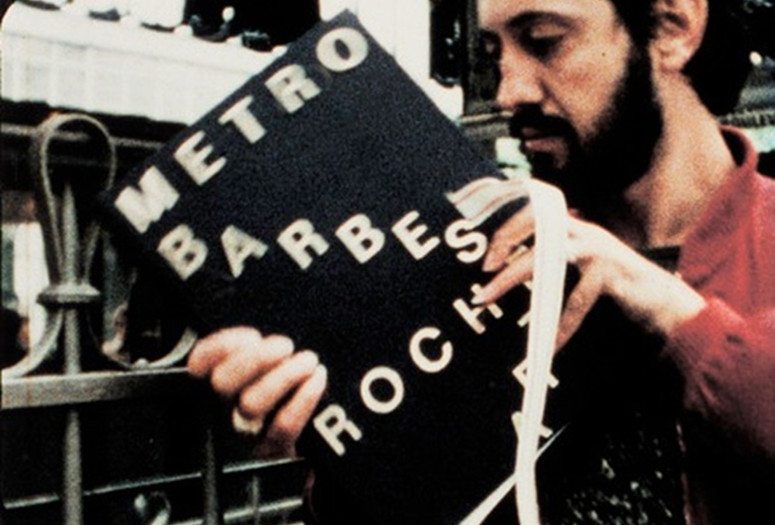
4 à 4 MétroBarbèsRochechou Art. 1980–83. France. Directed by MétroBarbèsRochecho Art. Super 8 mm transferred to 16 mm. Courtesy Mnam/Cci Centre Pompidou. 65 min.
“We decided that all of us would have the status of director, that everyone would participate in making the film, and at the same time the film would be a film about ourselves. So it was a matter of filming and being filmed. Each participant would film and would in turn be filmed by the others, and the result would be edited and shown together” (Teo Hernández). MétroBarbèsRochechou Art was the moniker used by Teo Hernández, Michel Nedjar, Jakobois, and Gaël Badaud for an informal collective that produced two films between 1980 and 1983. Close collaborators and reciprocal influences in their solo work, their only collective feature film expands their affinities into shared authorship, as each artist alternately films and is filmed, dissolving identity into a continuous present where gestures, performances, and chance encounters intertwine in a sketchbook of daily life. Each filmmaker’s identity, however, surfaces through constellations of objects and images (masks, film magazines, Mexican textiles, crystals, feathers, tunics), linking personality to gesture, memory, and private symbolic worlds. 4 à 4 traces an affective map of coded spaces (metro stations, parks, fountains, apartments, bridges), sites of daily encounter that form an imagined neighborhood.