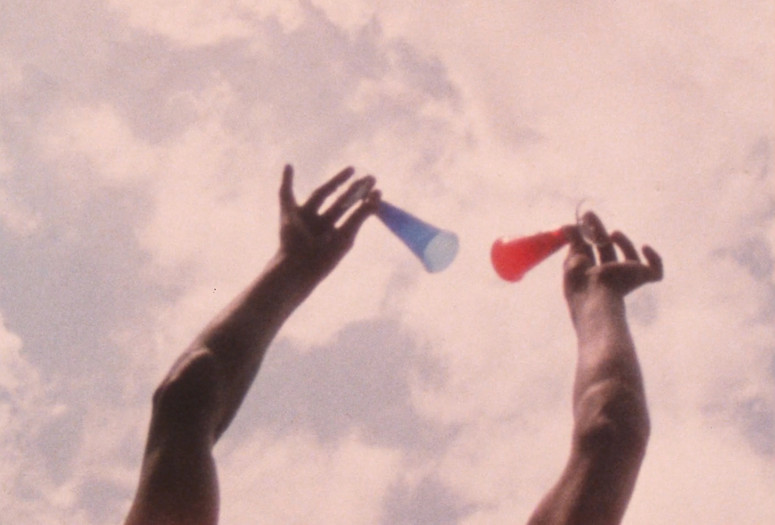
Graal. 1980. France. Directed by Teo Hernández. Super 8 mm transferred to 16 mm. Courtesy Mnam/Cci Centre Pompidou. Silent. 77 min.
“Why do we see the sky so often in my films? It is not some obscure theological desire, but the space that brings two worlds together: America and Europe. When I look at the sky, I tell myself: this is the space we share. Through the sky I can move from one cultural context to another” (Teo Hernández). Shot around a picnic-in-the-park situation, the last in the four-film cycle The Body of the Passion transforms simple cups into shifting vehicles of symbolic and sensorial intensity. The endless variations of filming and performative gestures, punctuated by the red- and blue-tinting of the image through color gels, generate a dilated time in which meaning continually mutates: the same sequence may suggest Eucharistic gravity, erotic encounter, pagan rite, or cosmic metaphor. Performers and camera move in rhythmical, reciprocal suspension, animating a floating world where gravity, narrative, and fixed identity dissolve. Rather than depicting the myth of the Grail, the film proposes the grail as a sign of how everyday life may become the site of myth’s perpetual reactivation.