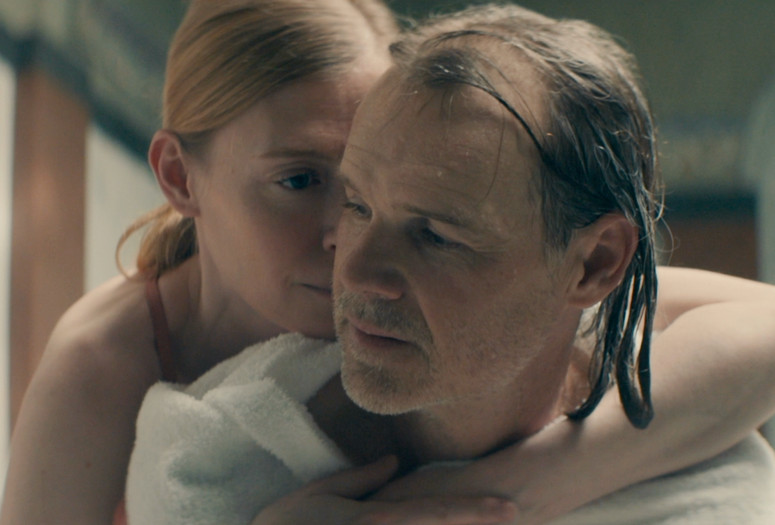
The Silent Treatment. 2025. Belgium/Hungary/Netherlands/Germany. Written and directed by Caroline Strubbe. With Kimke Desart, Zoltán Miklós Hajdu. Cinematography by David Williamson. Edited by David Verdurme, Louis Deruddere, Arthur Nelissen. Music by Albert Márkos, Aino Peltoma. In Hungarian, German, Dutch, English; DCP. 125 min.
Eleven years after the second installment, Strubbe’s trilogy culminates in Budapest, where an 18-year-old Tess—eccentric, compulsive, and exhibiting what the film identifies as Stockholm syndrome—has tracked Szabolcs down and begun stalking him. His girlfriend Andrea, occupying the role of outsider and potential mediator, attempts to broker a confrontation that allows all three to reckon with a shared traumatic history. Strubbe trades the vacant, post-industrial spaces of the first film and the flat coastal grays of the second for Budapest’s layered urban textures, a visual shift that mirrors the trilogy’s movement from open landscape to the compressed interior spaces where the past must finally be negotiated face to face.
Kimke Desart, who was nine years old when Lost Persons Area was filmed, is now an adult—a social worker in her daily life—and has literally grown into the emotional complexity the role demands. The film premiered at Film Fest Gent in October 2025. Strubbe has identified the final monologue’s deliberate echo of *Five Easy Pieces*—a character choosing, again, the flight that solves nothing—as the moment the trilogy’s long argument about forgiveness and its limits crystallizes into something approaching resolution, though the film, characteristically, refuses to make resolution feel easy.