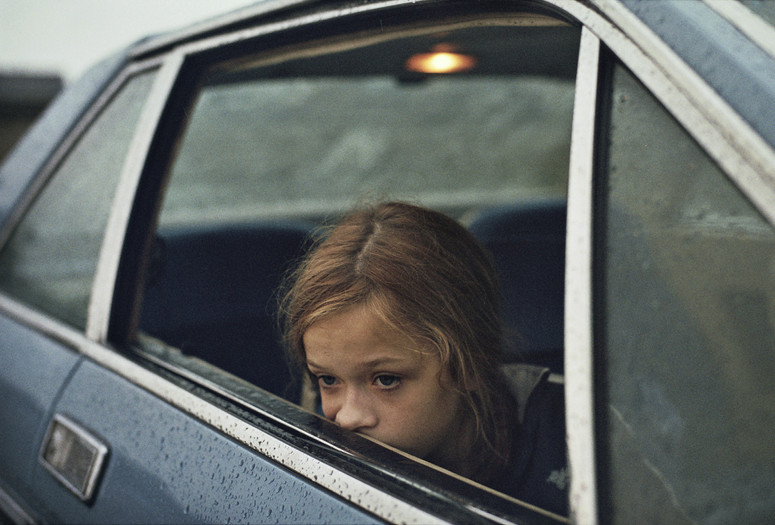
I’m the Same, I’m an Other. 2013. Belgium/Netherlands/Hungary. Written and directed by Caroline Strubbe. With Zoltán Miklós Hajdu, Kimke Desart. Cinematography by David Williamson. Edited by David Verdurme. In English, Dutch, Hungarian; DCP. 103 min.
Where Lost Persons Area is charged with suppressed domestic tension, the trilogy’s second installment moves almost entirely into silence; Strubbe has described the film as practically a silent work. Szabolcs and an adolescent Tess make their way from the Flemish coast to an out-of-season English seaside resort—the reasons for their flight westward are revealed only gradually—the film’s muted palette of gray water and empty promenades registering a mourning that neither character can articulate. The formal restraint is considerable, but what accumulates beneath it—the specific way Hajdu and Desart occupy space relative to one another, the incremental negotiations of proximity and distance—gives the film its emotional weight.
I’m the Same, I’m an Other premiered in the Wavelengths section of the 2013 Toronto Film Festival, and screened at MoMA in 2014, paired with Lost Persons Area, before the trilogy’s final installment was begun. Seen now, with that final installment in hand, I’m the Same, I’m an Other emerges as the trilogy’s still center—a two-character study of people learning, slowly and at considerable cost, to remain alive in the world.