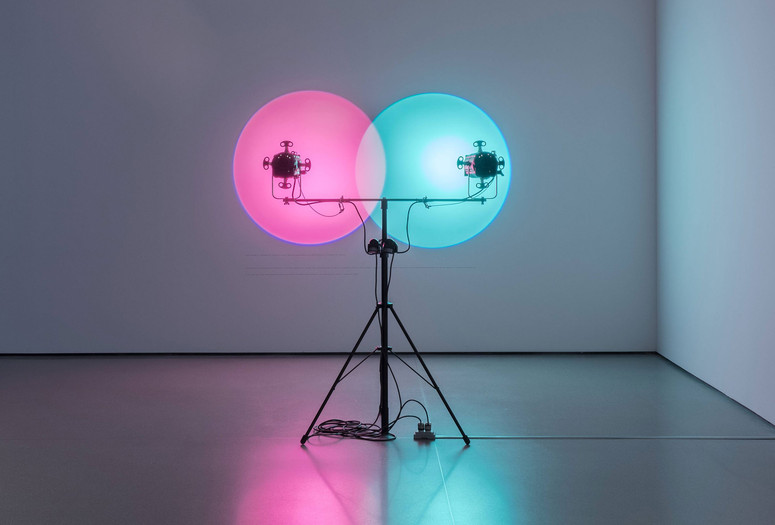
As part of its ongoing, in-depth study of MoMA’s Latin American art holdings, the Cisneros Institute hosts an annual online seminar series, with each installment offering a unique and focused critical perspective on the collection.
This year’s session, Politics of Light, will reflect on three Latin American artworks that utilize light as a central artistic material to explore issues of democracy and visualization. The works discussed will be Rosângela Rennó’s Untitled (red boy) (1996), Amalia Pica’s Venn Diagrams (Under the Spotlight) (2011), and Alfredo Jaar’s Lament of the Images (2002). As these three artists show, light—a natural agent associated with illumination and transparency—has the potential to obscure, mask, and blind, subverting the idea of light as a channel of truth. Although Rennó, Pica, and Jaar created these works in response to distinct political contexts, they all address issues of censorship, access to information, and the erasure of political memory.
The program will bring together scholars Ana Maria Maia, Eugenio Viola, and Erich Kessel Jr. to analyze these works with the following questions in mind: How do artists use light differently (and perhaps against) the viewers expectations, and to what ends? What about light’s material specificity lends it to discussions of power, democracy, and control? What are the conceptual underpinnings of a strained visual perception? What artistic strategies does the artist invent or employ to disengage from traditional modes of representation?
The discussion will be moderated by Elena Shtromberg and conducted in English with simultaneous Spanish translation.
Speakers
Ana Maria Maia is a researcher, curator, and professor of modern and contemporary art who lives in São Paulo, Brazil. Since 2019, she has worked at the Pinacoteca de São Paulo, where she currently serves as chief curator. Some of her latest exhibitions at the museum include Jonathas de Andrade: Pounce and Bounce (2022), Marta Minujín: Live (2023), and Lygia Clark: Project for a Planet (2024). Maia holds a PhD in art theory, history, and criticism from the University of São Paulo. She is the author of the books Flávio de Carvalho (2014) and Arte-veículo: intervenções na mídia de massa brasileira [Vehicle-Art: Interventions on the Brazilian Mass Media] (2015), the latter of which was awarded the Critical Production Stimulus Grant by the Brazilian Ministry of Culture.
Eugenio Viola, PhD, is the current artistic director of MAMBO, the Bogotá Museum of Modern Art in Colombia. He was senior curator at the Perth Institute of Contemporary Arts (PICA) in Western Australia from 2017 to 2019 and held curatorial positions at the MADRE Museum in Naples, Italy, from 2009 to 2016. Viola curated the Estonian Pavilion at the 56th Venice Biennale in 2015 and the Italian Pavilion at the 59th Venice Biennale in 2022. In 2025, he served as general curator of The World Tree, the 24th Arte Paiz Biennale in Guatemala. He has curated more than 100 exhibitions internationally and collaborated with a wide range of global institutions. Viola is also a scholar specializing in performance and the body. He has published extensively and edited over 60 catalogues and books, and regularly contributes to publications such as Artforum and Italian Arte. He frequently lectures at academic and art institutions and participates in international panels and juries.
Erich Kessel Jr. is an assistant professor at the Institute of Fine Arts. He is a scholar of Black diaspora arts and critical theory. His current research engages dominant formations of the image to interrogate the racial aesthetics and politics of the term “capture,” a metaphor describing the mechanisms of mediation and perception. Kessel’s teaching focuses on contemporary art, racial genealogies of modern thought, and art-historical method. In addition to the co-edited art book An Excess of Quiet: Selected Sketches by Gustavo Ojeda, 1979–1989, his work has appeared or is forthcoming in Theatre Journal, Discourse, and The Routledge Companion to Queer Art History. He is an alumnus of the Whitney ISP Critical Studies Fellowship and received his PhD in history of art and African-American studies from Yale University.
Respondent and moderator
Elena Sthromberg is professor of art history at the University of Utah. Her book Art Systems: Brazil and the 1970s (2016) explores visual forms of subversion during the height of the Brazilian dictatorship. She has curated a number of exhibitions, among them Video Art in Latin America, part of the Getty Foundation’s 2017 initiative PST: LA/LA, accompanied by the co-edited volume Encounters in Video Art in Latin America (2023). Most recently, she co-curated Transgresoras: Mail Art and Messages, 1960s–2020s (2025), which focused on an intergenerational group of Latin American and Latinx women artists working with mail art, at the California Museum of Photography (on national tour until 2028 and with an accompanying publication forthcoming in 2026). She is currently working on the book project Mobile Memories: Video Art and the Politics of Remembering.