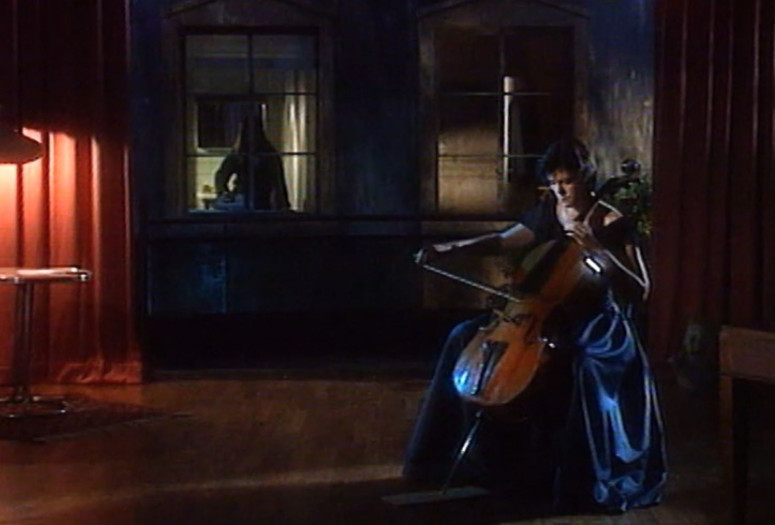
Trois strophes sur le nom de Sacher (Three Stanzas on the Name Sacher). 1989. France. Written and directed by Chantal Akerman. DCP courtesy Royal Film Archive of Belgium — CINEMATEK and Fondation Chantal Akerman. In French; English subtitles. 12 min.
While a strange domestic drama plays out in the rear window of a stylized moonlit setting, Sonia Wieder-Atherton performs Henri Dutilleux’s Three Stanzas on the Name Sacher, a difficult piece composed in 1976 for solo cello in tribute to the Swiss conductor Paul Sacher. Chantal Akerman, modeling the editing and pacing on the idea of the strophe, or metrical unit, films Wieder-Atherton’s face in close-up in the second part, describing it as “reminiscent of those of the great actresses of silent cinema.” She observes that “Dutilleux’s music could seem to come immediately from the emotions that drive her. The editing contributes to its tension, which is the very tension of the work. A sound that permeates the space. A very pure, very sober overall effect, which allows this music, which vacillates between control and flight, to express itself powerfully in this night.”
Avec Sonia Wieder-Atherton (With Sonia Wieder-Atherton). 2003. France. Written and directed by Chantal Akerman. DCP courtesy Royal Film Archive of Belgium — CINEMATEK and Fondation Chantal Akerman. In French, with English subtitles. 54 min.
Chantal Akerman’s love letter to the cellist Sonia Wieder-Atherton is at once a concert film, an essay film, a portrait, and an installation piece. Akerman observes, “It is said of Sonia Wieder-Atherton that she chose the cello because she wanted to play a stringed instrument whose sound she could make last as long as she wanted. This is true. It is said that she plays Schumann, Shostakovich, Elgar or Bruch. That she goes from Monteverdi to Kurtág, from Bach to Dusapin or Dutilleux without any transition. It is true.” Wieder-Atherton’s discovery of music from the East—Dvořák, Janáček—showed her a different way to play the cello, a different interpretation and sound, and her love of Maria Callas taught her that the instrument could, with the right phrasing and weight, resemble the human voice.