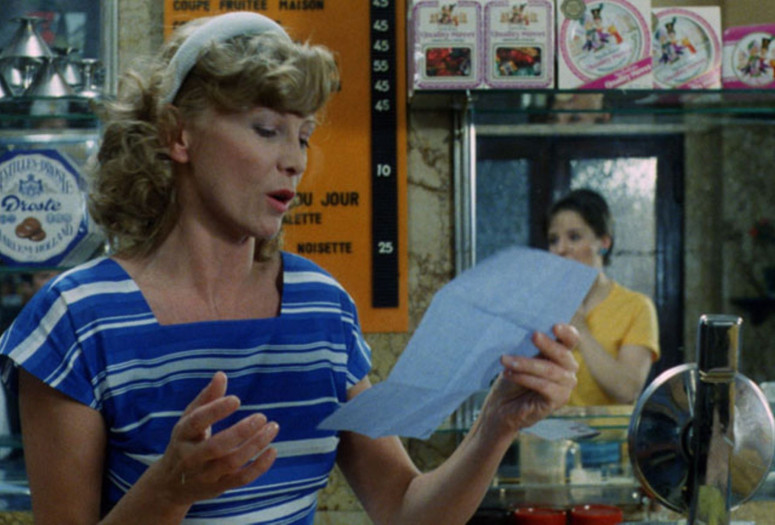
Family Business. 1984. UK. Written and directed by Chantal Akerman. With Akerman, Colleen Camp, Aurore Clement. DCP courtesy Royal Film Archive of Belgium —CINEMATEK and Fondation Chantal Akerman. In French and English; English subtitles. 18 min.
Richard Brody calls Family Business “a tour de force of comedy, both physical and verbal, about the variety of indignities that the movie business inflicts on its eager and earnest participants. It’s also a dazzling bit of multilevel metafictional whimsy.” Chantal Akerman wants to make her musical Golden Eighties in the United States…in English. No one will fund it. Her mother encourages her to track down her (imaginary) rich American uncle in Los Angeles. This ingenious little film is Akerman’s slapstick attempt to hit him up for money, though he’s nowhere to be found. Instead she discovers Aurore Clément, the star of her film Les Rendez-vous d’Anna, poolside at the home of her uncle’s girlfriend. They read lines from an English-language script that just happens to be that of Golden Eighties. Clément struggles to pronounce the words “cheated” and “rotten.”
Les Années 80 (The Eighties). 1983. Belgium. Directed by Chantal Akerman. Screenplay by Akerman, Jean Gruault. With Aischa Bentebouche, Katherine Best, Francois Beukelaers. DCP courtesy Royal Film Archive of Belgium — CINEMATEK and Fondation Chantal Akerman. In French, English subtitles. 79 min.
Chantal Akerman shows her playful side in this trial run for Golden Eighties, a backstage musical in two embryonic acts that she made as a proof-of-concept for potential funders of her feature film—and as a conceptualist tribute both to her cast and crew and to the game of making movies. The first part, shot on video, involves Akerman as the director, choreographer, conductor, and singer of her own songs, auditioning and reading lines with the actors, staging their movements and dance routines, and forging their stock melodramatic roles—the coquette and the spurned fiancée, the obsessive suitor and the indifferent cad—into a rich and varied portrait of l’amour fou. The second part, filmed on 35mm, is an amuse bouche of the MGM- and Jacques Demy-inspired musical numbers she hoped to celebrate and deconstruct in Golden Eighties.