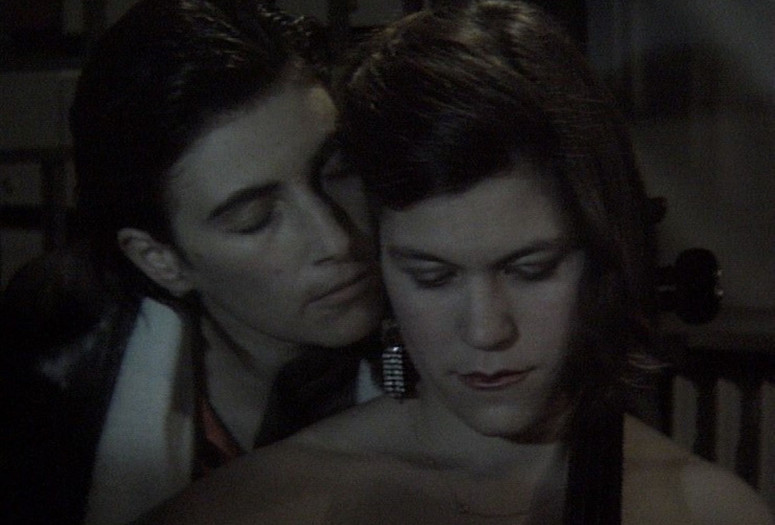
Lettre de cinéaste (Letter from a Filmmaker). 1985. France. Written and directed by Chantal Akerman. 2K restoration courtesy INA. In French; English subtitles. 8 min.
In this sendup of filmmaker master classes, Chantal Akerman riffs on the expression “by the letter.” Together with her shadow, Aurore Clément (Rendez-vous d’Anna), she reflects on God, Raiders of the Lost Ark, sloth, doubt, fathers and sons, aniconism and authorship.
Rue Mallet-Stevens. 1987. Belgium. Written and directed by Chantal Akerman. With Akerman, Sonia Wieder-Atherton, Robert Weyergans, Roberto Prual-Reavis, Jean-François Schneider, Coralie Seyrig, Marc Atherton, Camille Bordes-Resnais. DCP courtesy Royal Film Archive of Belgium — CINEMATEK and Fondation Chantal Akerman. No dialogue. 8 min.
The French-Belgian modernist architect and designer Robert Mallet-Stevens, a lesser-known contemporary of Le Corbusier and Mies van der Rohe, is largely remembered for his Villa Noialles, a functionalist masterpiece that inspired Man Ray’s 1929 film The Mysteries of the Château de Dé. Mallet-Stevens also designed the sets for Marcel L’Herbier’s silent film L’Inhumaine, as well as five 1920s modernist townhouses for wealthy bohemian aesthetes on a private street in the Auteil section of Paris’ posh 16th Arrondisement. Inspired by his rigorous experimentation with form, Chantal Akerman shot this short “protest” film—an appeal to save the Royal Film Archive of Belgium—on rue Mallet-Stevens, using structuralist film techniques (the use of jump cuts and asynchronous sound) and melodramatic, even surrealist, gestures.
Dis-moi (Tell Me). 1980. France. Written and directed by Chantal Akerman. 2K restoration courtesy INA. In French; English subtitles. 45 min.
Three elderly Jewish women who survived the Holocaust invite Chantal Akerman into their Parisian homes. They tell colorful stories of arranged marriages, dowries, folk songs, and Russian pogroms; of their own grandmothers, with their comforting scent of rose perfume and heroic resolve; of exile from Poland and Palestine and the sense of betrayal after France rounded up their families to be gassed at Auschwitz. They speak, as well, of hunger—“Eat or else I won’t tell you the rest,” one storyteller admonishes Chantal—and of taking in war orphans and having children and grandchildren of their own to feel alive again. Akerman’s mother Natalia is heard but not seen as she describes the grandmother she lived with when she returned from Auschwitz, where her parents were murdered. What’s left unspoken, but felt acutely in Akerman’s face, is the pressure on the children of survivors to fill this void born of trauma. The film’s ending, involving an episode of The Untouchables, is utterly knowing.
Program 65 min.