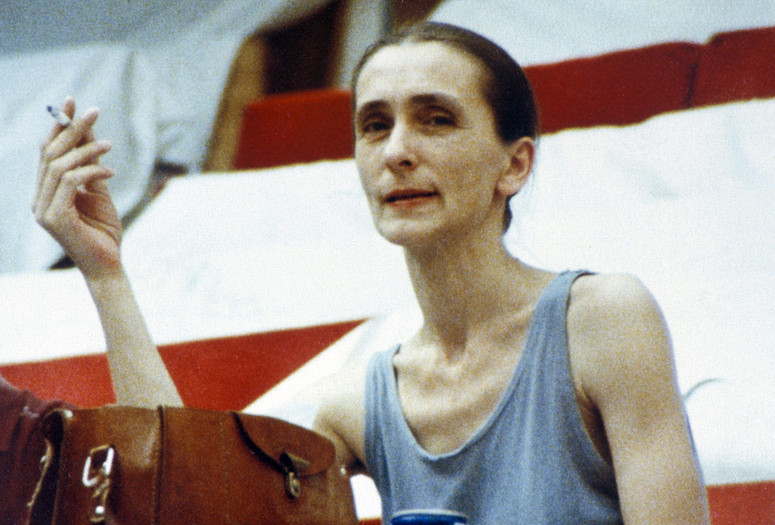
Un jour Pina a demandé… (One Day Pina Asked). 1983. France. Directed by Chantal Akerman. Screenplay by Akerman and Alain Plagne. 2K restoration courtesy INA. In French; English subtitles. 57 min.
For five weeks in 1980, Chantal Akerman followed the German choreographer Pina Bausch and her Tanztheater Wupperthal company as they rehearsed and staged performances in Milan, Venice, and Avignon. Drawn as they both were to what Akerman called Bausch’s “sadistic horror amidst beauty,” it was as though an electric current ran between them. The film’s opening commentary might well be describing Akerman herself: “Pina Bausch constructs her pieces from collages, very subtle musical montages, stereotypical gestures, repetitive situations, and often autobiographical elements contributed by the dancers themselves…. [The dancers] talk to us about love, tenderness, and how they strip bare ‘dressed up’ behavior, which often veers towards ambiguity, misunderstandings, hysteria and violence. Pina Bausch is 40 years old and her memories are those of Germany in the difficult years.”
Les trois dernières sonates de Franz Schubert (Franz Schubert's Last Three Sonatas). 1989. France. Written and directed by Chantal Akerman. 2K restoration courtesy INA. In English; French subtitles. 49 min.
Between the spring and autumn of 1828, when Franz Schubert, at age 31, knew he was dying of syphilis-related complications, he composed his last three sonatas. Chantal Akerman visits the Czech-born Austrian pianist Alfred Brendel at his Hampstead studio, where he performs and reflects on these compositions, which he himself helped rescue from oblivion. She structures the opening of her own film according to the first movement of Schubert’s Sonata in C Minor. Brendel, who died this past June at 94, illustrates Schubert’s need for proportion and space in his compositions (as we, in turn, reflect on Akerman’s own similar need) and compares Schubert’s approach to form and chaos with those of Haydn, Mozart, and Beethoven. He concludes that Schubert, facing death, had become “a wanderer at the precipice,” a paragon of the Romantic condition.