La Chambre (The Room). 1972. Belgium. Written and directed by Chantal Akerman. 2K restoration by the Royal Film Archive of Belgium — CINEMATEK and Fondation Chantal Akerman; DCP courtesy Janus Films. No dialogue. 11 min.
Hailed by Jim Hoberman as “arguably the most important European director of her generation,” Chantal Akerman spent 18 months in New York in the early 1970s working odd jobs (including porno movie theater cashier) and discovering the films of Michael Snow, Stan Brakhage, Ernie Gehr, and Hollis Frampton at Anthology Film Archives. If Jean-Luc Godard’s Pierrot le fou inspired her to become a filmmaker at the age of 15, these artists excited her to the possibilities of experimenting with stillness and movement, duration, silence, and abstraction. In La Chambre, Akerman and cinematographer Babette Mangolte survey a cramped tenement apartment through several slow, repeated pans and counterpans in a manner reminiscent of Michael Snow’s recent La région centrale (1971), making out of domestic objects—a table, a chair, a tea kettle—a still life of subtle variation and unexpected meaning. Into this cloistered space Akerman suddenly appears, an odalisque bathed in the morning light as she lazily recovers from shooting Hotel Monterey the day before and suggestively takes a bite out of a big red apple.
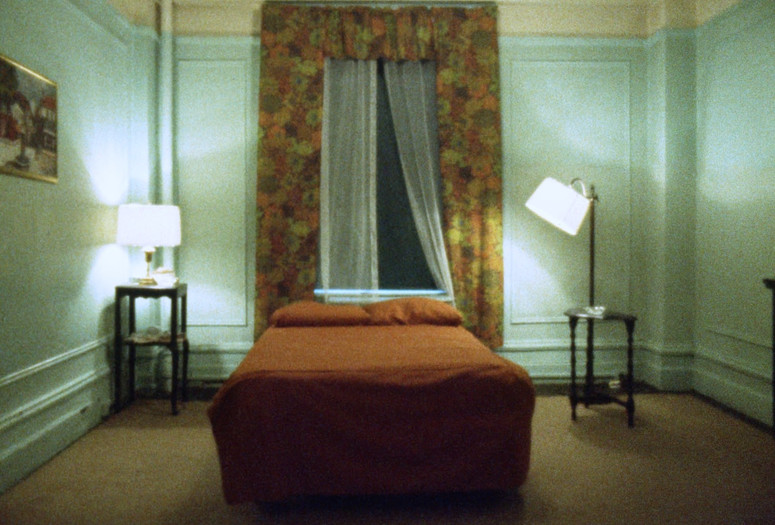
Hotel Monterey. 1972. Belgium. Written and directed by Chantal Akerman. 2K restoration by the Royal Film Archive of Belgium — CINEMATEK and Fondation Chantal Akerman; DCP courtesy Janus Films. No dialogue. 62 min.
With its contemplative, haunting beauty, Hotel Monterey recalls the paintings of Johannes Vermeer, Edward Hopper, and Vilhelm Hammershøi. Chantal Akerman charts a derelict New York hotel over the course of a single night, ascending from its stygian depths to its rooftop in the watery-gray light of dawn. Capturing the building’s spectral inhabitants as they peer curiously through portholes, down dingy desolate hallways, and at the camera itself from their sepulchral rooms (shades of the Overlook Hotel), Akerman would later describe “a flat pissy yellow light like the yellow lights of bad dreams.” J. Hoberman writes, “This formalist investigation of a seedy SRO hotel on the Upper West Side fragments the building into a succession of leisurely contemplated vistas—the lobby, the rickety elevator, the cramped rooms, the inexplicable fixtures. Initially impressionistic, Hotel Monterey is actually quite rigorous in its painterly—not to mention eroticized—use of narrow corridors and light-smeared reflections ([cinematographer Babette] Mangolte again).”